
AI keeps changing what’s possible, what it costs and what can go wrong. At the 2026 Executive Summit by unosquare, senior technology and business leaders traded notes on leading teams through goals that won’t sit still.
Key Takeaways
- AI is moving the goalposts in three ways at once: what models can do, what it costs to build software and how fast security threats move. On the public Mensa Norway IQ test, models released in 2023 scored roughly 80 to 85. The best models now score 148 to 151.
- Leaders can’t stop the goalposts moving, but they decide how those moves land on their teams. That is the core of AI change management.
- Six habits help: start governing before you feel ready, anchor on an outcome you control, love the problem rather than your current answer, explain every change, use the tools yourself and don’t hide behind a committee.
- Moving the goalposts is not the failure. Failing to explain why they moved is.
- Tie AI to revenue, not only to savings. Boards will keep asking what AI delivers beyond cost cutting, and leaders who can’t show top-line impact will struggle to win support for the next phase of AI transformation.
- Using AI won’t win people over on its own. Some clients and employees, including many younger people, are wary of handing everything to AI, so show them where people stay in charge and what the change does for them.
“Who here has been part of a company where leadership changed the goalposts?”
Nearly every hand in the room went up. Then our moderator, Chief Commercial Officer Joel Barrett, asked who liked it. The room laughed.
If you lead technology, you have probably been on both sides of that question. Everyone in that room had. AI keeps changing the plan under them, and every change lands on the teams they lead. They are the ones moving the goalposts now.
Nobody there doubted that AI will change how their companies work. The harder question, the one that filled three days, was how to lead people through it. That is the real work of AI change management, and the answers had more to do with leadership than with models.
How AI Is Moving the Goalposts
Two keynotes set out what is driving the change. Any one of these shifts can change what a team should be working on halfway through a plan.
1. What AI can do keeps jumping
David Lee leads applied AI research and development at a large U.S. enterprise, and he opened the summit with a chart of AI IQ scores. TrackingAI, a project run by Maxim Lott, tracks those scores publicly by giving models the puzzles from human IQ tests.
The climb is steep. On the public Mensa Norway test, models released in 2023 scored roughly 80 to 85. In September and October 2026, the best models scored 148 to 151. TrackingAI also runs a test whose questions have never been published online, so no model could have seen them in training. On that one, the top score rose from about 86 in May 2024 to 136 in October 2026. Twenty dollars a month buys anyone access to that.
At David’s company, this is already ordinary. About 70% of corporate employees use AI every week. More than 1,000 people have built agentic workflows that now run about 60,000 times a week, and the internal AI community he helped build has grown to 2,000 members, from beginners to experts.
He called programming “a completely solved science,” pointing out that some of the best-known engineers in the field say they no longer write code themselves. The tasks agents can finish on their own are getting longer too. METR’s research found that length doubled roughly every seven months over six years, and David said frontier labs have now run autonomous agents on tasks lasting two and a half weeks. A goal sized for last year’s tools may already be too small.
Our pre-summit survey showed where attendees feel it most. Two answers stood out: too few people who know how to do this work and too little adoption across the organization.
2. Building is getting cheaper than renting
Giancarlo Di Vece, our CEO, came at the same shift from the delivery side. We started in staff augmentation 17 years ago. Today, two engineers are building a full platform for one client’s new business unit.
When building gets that cheap, licensed software looks different. Giancarlo’s name for the response is decommission-as-a-service. Picture a company paying $2 million to $5 million a year for a Salesforce or SAP implementation it only partly uses. It replaces that platform with a custom build it pays for once, and the savings go straight to EBITDA.
Licenses that almost fit used to be the safe choice. Now they are often the expensive one. That is the case for owning custom-built software instead of renting it, and for fixed-fee delivery where scope, price and acceptance criteria are agreed before the build starts.
3. The threats are moving faster too
David’s other chart was harder to look at. The count of publicly known software vulnerabilities is climbing almost straight up. He described AI agents as multiplying the number of security researchers on Earth by a factor of a thousand. Attackers get them too, which is why he sees security becoming “swarms versus swarms.” He also passed on a report that the CEO of one large bank is trying to move 70% of the bank’s technical staff to cyber defense.
Identity is shifting under all of this. Nate Szytel, CEO of Next Reason, has spent about 15 years in identity and access management, and he described how the old model breaks. Systems used to verify a person once, at login, and trust them from then on. Now perimeters move and AI agents act on people’s behalf, so every request needs checking.
Zero trust answered that with “never trust, always verify.” Nate’s team has recast it as “continuous identity,” meaning systems that keep reading signals about what a person is doing and in what context. Standards such as the Shared Signals Framework let those systems pass security events to each other as they happen.
So plan security on day one. An AI program that waits for its first agent to reach production has waited too long.
Six Habits for Leading AI Change
Both keynotes ended in the same place. The technology works and the economics favor building. What’s left is whether leaders can move fast enough without losing the people who do the work.
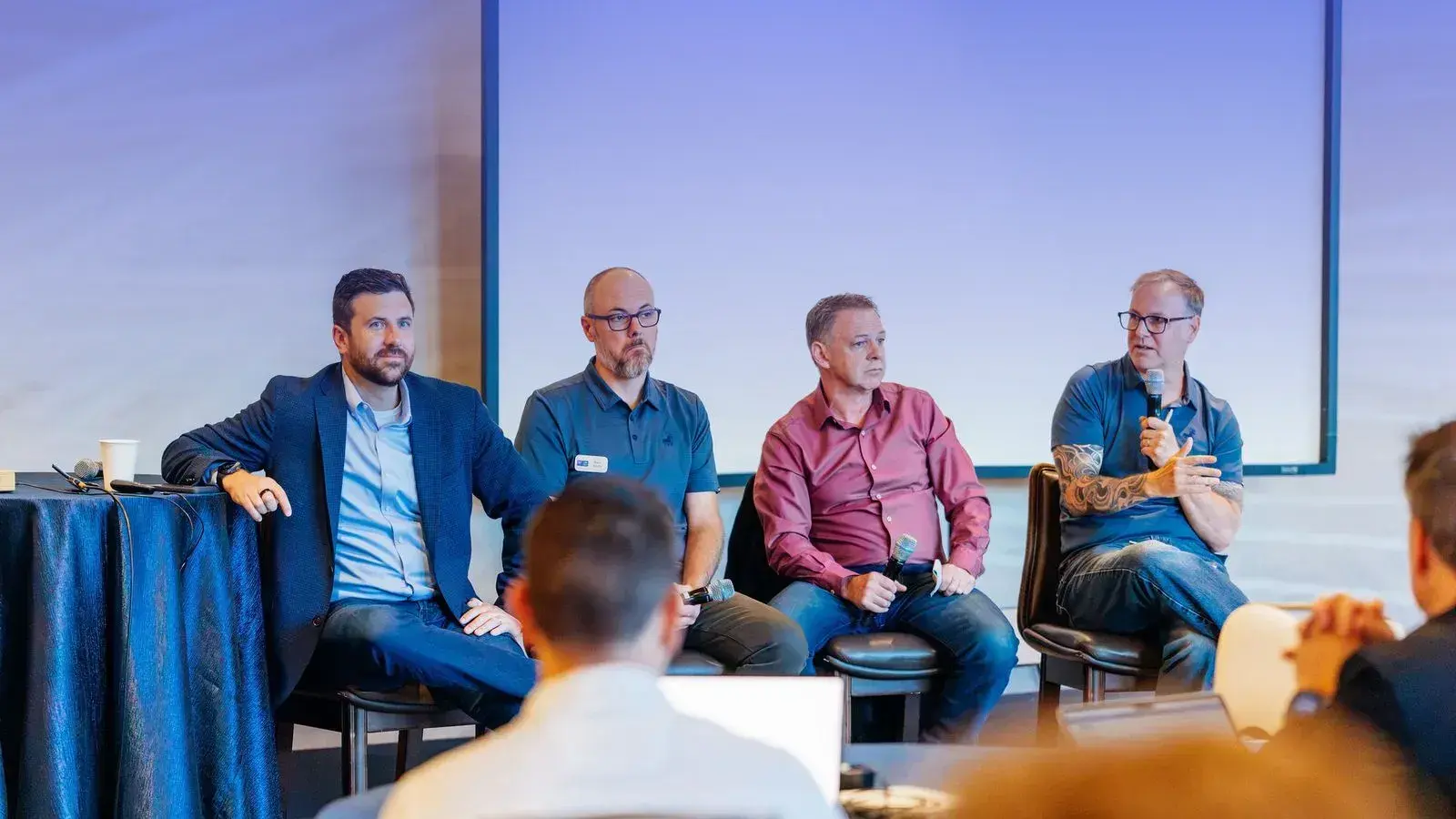
The client panel picked that up on the last morning. Nate was joined by Ken Griffin, IT operations advisor at Teletrac Navman, who spent years leading enterprise risk at HP, and Derwyn Harris, CPO of Joonbi, who co-founded Jama and grew it to 200 people. Between the panel and the roundtables, six habits came through.
1. Start governing before you feel ready
Your people are already using AI. Most companies still govern it with processes built for technology they understand, which Ken compared to playing a sport without knowing the rules.
“I don’t know how to do it, but we have to start,” he said. Name the problem. Give it an owner. Decide how that owner makes decisions and explains them. Begin with what you know you don’t want and adjust as you learn. The one option that fails is leaving the gap open, because people will fill it on their own.
A first rule can be small. One panelist’s company sorts every AI use into human in the loop, human on the loop or human out of the loop, and settles the category before anything gets automated. Our guide to AI governance evidence you can pull on demand goes further.
2. Anchor on an outcome you control
If the tools change every few months, the goal can’t be tied to them. Ken’s example was cutting customer onboarding time in half, an outcome the business owns and can hold steady while the models underneath it change. It gives people one fixed point when everything else is moving.
3. Fall in love with the problem, not the solution
This is an old product rule, and Nate lives by it. Review your goals often, expect them to change and stay attached to the customer’s problem rather than your current answer to it. He also makes a habit of questioning his own industry. Why should anyone need an account to switch on a smart light bulb? It’s an odd question from someone whose business is login, and that’s the point. When the market shifts, his team has already heard the argument.
4. Sell every move
Here is where that show of hands paid off. Derwyn’s answer was two words: sell it.
Leaders will move the goalposts, and with AI they will move them often. Each time, they owe their people a clear reason, grounded in reality, for why the goal changed. People follow a reason they understand. Moving the goalposts is not the failure. Failing to explain why they moved is.
5. Drive it yourself
Giancarlo’s message to the room was that this change can’t be handed off to engineering or to a vendor. Use the tools yourself, on your own work, before you ask your teams to change how they work. Leaders who have done that know what the tools can do, and they set expectations everyone else can meet.
6. Don’t hide behind a committee
Ken called it the worst response to a hard decision: set up a committee. Joel, a World War II history buff, had a story to go with it. In 1944 the U.S. Office of Strategic Services, the forerunner of the CIA, wrote a Simple Sabotage Field Manual that taught ordinary citizens to undermine the enemy by doing their jobs badly. Managers got specific instructions. Refer all matters to committees for “further study and consideration.” Make those committees as large and bureaucratic as possible.
Nobody in the room missed the parallel to corporate AI programs.
Test the Idea Before You Form the Committee
A committee runs on opinions. A prototype gives it something real to argue about. Before you commit to anything, we work out what your AI use case has to do and build a working version you can click through. Then you get a written scope and a fixed fee to approve, and your leadership team decides with evidence in front of it. See how fixed-fee delivery works.
What Nobody Has Solved Yet
Two questions stayed open, and the leaders in the room didn’t pretend otherwise.
The first was revenue. Has AI directly grown your top line? There was plenty of evidence for lower costs and faster work. One team pointed an AI agent at the simplest technical debt it had: typos, wrong colors and old to-do comments left in the code. The agent fixed about 500 items and opened its own pull requests. Engineers only had to review them. It saved hundreds of engineering hours and added nothing to revenue.
One attendee rolling out AI coding tools to engineers expects the bill to land soon and wants results within six to nine months. If that sounds familiar, decide what outcome you expect before the rollout and measure against it. Make revenue part of that outcome. When boards see AI only as a way to cut costs, every next phase gets harder to approve. Our guide to enterprise AI adoption challenges covers settling ownership, roles and training before the build.
The second was trust. One panelist recently spoke to about 100 high school students, and every one of them was against AI and trying to stay away from it. They are not alone. Some clients and employees of every age are wary of handing everything to AI, and rolling out more of it won’t change their minds. Showing them where people stay in charge, and what the change does for them, will go further.
One line from the roundtables covers both. AI makes a well-run process better. Added to a poorly run one, it makes the mess faster.
Start With One Use Case That Matters
AI will keep moving the goalposts, and no committee will slow it down. The leaders who come out ahead will explain every move and test ideas before anyone schedules a meeting about them.
If there’s an AI use case on your list right now, start there. We’ll build a working prototype before you commit to anything, then give you a written scope and a fixed fee for the full build. Start with a prototype.
This piece draws on the 2026 Executive Summit by unosquare, held October 25 to 27, 2026 in Las Vegas. We bring senior technology and business leaders together for conversations like these, by invitation. If you’d like a seat at a future summit, tell us about your priorities.
References
-
Lott, M. (n.d.). Top AI IQ scores over time. TrackingAI. https://www.trackingai.org/top-iq
-
Lott, M. (2024). AIs ranked by IQ; AI passes 100 IQ for first time, with release of Claude-3. Maximum Truth. https://www.maximumtruth.org/p/ais-ranked-by-iq-ai-passes-100-iq
-
METR. (2025). Measuring AI ability to complete long software tasks. METR. https://metr.org/blog/2025-03-19-measuring-ai-ability-to-complete-long-tasks/
-
Rose, S., Borchert, O., Mitchell, S., & Connelly, S. (2020). Zero trust architecture (NIST Special Publication 800-207). National Institute of Standards and Technology. https://csrc.nist.gov/pubs/sp/800/207/final
-
OpenID Foundation. (n.d.). Shared Signals Working Group. OpenID Foundation. https://openid.net/wg/sharedsignals/
-
Central Intelligence Agency. (n.d.). The art of simple sabotage. CIA.gov. https://www.cia.gov/stories/story/the-art-of-simple-sabotage/
Our Editorial Standards
unosquare is committed to publishing accurate, well-researched information about B2B software delivery. Our editorial team reviews every article for accuracy and draws on reputable sources, including industry analysts, standards bodies, academic institutions, peer-reviewed research, and established enterprise technology providers. References are checked for accessibility and relevance at the time of publication.
We work hard to keep our content accurate, but mistakes can happen, and information may change as delivery models, pricing benchmarks, and technology standards evolve. If you notice an error or outdated information, please contact us so our team can review it.
Important Disclaimer
The information on this website is provided for general educational and informational purposes. It is not legal, financial, or technical implementation advice. Before making decisions about software investments, vendor selection, or delivery models, consult the appropriate technology, legal, and financial professionals. unosquare is not responsible for actions taken solely on the basis of the information presented here.
Frequently Asked Questions
- What is AI change management?
- AI change management is the work of helping people adjust as AI changes their goals, tools and roles. AI capabilities and costs shift every few months, so it works less like a single rollout plan and more like a habit. Set an outcome the business controls, explain every change to the goal, put governance in place early and test ideas with working prototypes before debating them in committee.
- How is AI moving the goalposts for business leaders?
- Three things are changing at once. What AI can do keeps jumping. On the public Mensa Norway IQ test, models released in 2023 scored roughly 80 to 85, and the best models now score 148 to 151, according to TrackingAI. Building custom software is getting cheaper than licensing platforms that almost fit. And AI is speeding up both attacks and defense in cybersecurity. Any one of these shifts can change what a team should be working on halfway through a plan.
- How should leaders change goals without losing their team?
- Explain every change. The technology leaders at our 2026 Executive Summit agreed that moving the goalposts is not the failure. Failing to explain why they moved is. Anchor on an outcome the business controls, stay attached to the customer's problem rather than your current answer and give people a clear reason, grounded in reality, whenever the goal changes.
- How should executives start governing AI when the rules are still unclear?
- Start before the framework is perfect. Ken Griffin, IT operations advisor at Teletrac Navman, suggested naming the problem, assigning an owner and deciding how that owner makes and explains decisions. Begin with what you know you do not want to happen and adjust as you learn. Leaving the gap open is the riskiest option, because people will fill it on their own.
- What is decommission-as-a-service?
- It is an approach Giancarlo Di Vece, CEO of unosquare, described at the summit. A company replaces a costly licensed platform, such as a Salesforce or SAP implementation costing $2 million to $5 million a year, with a custom build it pays for once. Many companies use only part of what those licenses include. When the build costs less than a few years of license fees, the savings go straight to EBITDA.
- What does continuous identity mean?
- It is how Nate Szytel, CEO of Next Reason, describes the next step after zero trust. Instead of verifying a person once at login, systems keep evaluating signals about what the person, or an AI agent acting for them, is doing and in what context. Standards such as the OpenID Foundation's Shared Signals Framework let systems share those signals with each other as they happen.
- Is AI showing up in the top line yet?
- For most of the executives at the summit, not directly. They had clear evidence of lower costs and faster work, such as an AI agent that cleared about 500 small technical debt items while engineers only reviewed the pull requests. Examples of new revenue were harder to find. Leaders building a business case should define the outcome they expect before a rollout, include revenue as well as savings and measure against it, because boards will ask what AI adds beyond cost cutting.
- Where do these insights come from?
- From the 2026 Executive Summit by unosquare, an invitation-only gathering of senior technology and business leaders held October 25 to 27, 2026 at Vdara in Las Vegas. The program combined two keynotes, roundtables for technical and business leaders, a client panel and time to connect outside the sessions.

Oscar Rank
Head of Marketing
Oscar Rank is the Head of Marketing at unosquare. He arrived there after a 15-plus year career spanning financial services, retail and technology. His path ran through product management, strategy, data and CRM roles before he made the jump into full-funnel marketing and GTM. He holds a degree in industrial engineering from the University of Toronto, with a specialization in human factors. That systems-first, human-centered mindset shows up in how he runs marketing: build the process, then let the data settle the argument. He writes about how software and AI are changing what’s possible for a business, and how that shifts the trade-offs leaders have to make.