
Phase 01 · Weeks 1 to 5
Overstaff
A launch team assesses your environment and deploys. We build the AppMap and an infrastructure-as-code baseline, and no alert goes live without a runbook. A go/no-go gate comes before go-live.

Ways to work with us
What we build
Technologies
We run and improve the software and cloud systems your business depends on, with clear SLAs and predictable costs. Our nearshore engineers monitor them 24/7, respond to incidents and fix the root cause behind each one. Your engineers get to build what’s next.

4.9 / 5.0
Clutch · Top Nearshore 2025

Trusted by











The basics
Managed IT services are the day-to-day running of your production systems by a provider that answers for them against agreed SLAs. unosquare runs managed application services and cloud operations with nearshore engineers, for systems you built, we built or someone else built. Start with one service and expand as the model matures.
NOC
24/7/365 monitoring on Datadog, SolarWinds or Dynatrace. Paging through PagerDuty or xMatters, ticketing in ServiceNow and SLA-driven incident response.
SRE + DevOps
Self-healing platforms, observability through OpenTelemetry and SLI and SLO governance. FinOps and capacity management, CI/CD on GitHub Actions, infrastructure as code in Terraform and secrets in Vault or Azure Key Vault.
IAM
Identity lifecycle automation, role-based access and zero-touch provisioning, with onboarding and offboarding triggered by HR.
CHG
ITIL v4, with a change advisory board for high-impact changes and expedited or automatic approval for standard ones.
SEC
Continuous scanning, with triage routed to development, SRE or network operations. Aligned to SOC 2 and HIPAA where your systems need it.
Tools are adopted to fit your stack and environment.
The real problem
The cost of downtime
$23,750/min
The average cost of enterprise downtime (ITIC and BigPanda, 2024).
Process risk
Our approach: Weekly problem management. Every P1 produces a permanent-fix ticket, tracked to leadership.
Recovery risk
Our approach: SRE owns documented runbooks and tested recovery procedures, and we validate RTO and RPO every quarter.
Configuration risk
Our approach: Two-track change management, with mandatory rollback documentation and a go/no-go gate.
How it works
We overstaff on deployment to reach your SLA targets, then right-size the team.
Phase 01 · Weeks 1 to 5
A launch team assesses your environment and deploys. We build the AppMap and an infrastructure-as-code baseline, and no alert goes live without a runbook. A go/no-go gate comes before go-live.
Phase 02 · Weeks 6 to 17
We right-size the team, and the launch engineers stay on call. The on-call rotation is documented and active, and SLA governance is live by week 15. Our target is 70% less alert noise by week 15.
Phase 03 · Weeks 18 and on
You get a monthly dashboard in green, amber and red, and we run weekly problem management reviews. Every P1 and P2 produces a permanent-fix ticket, and we track the root cause resolution rate monthly.
Engagement path: Step 1, an assessment, which you can also buy on its own. Step 2, a NOC rollout. Step 3, expand into SRE, DevOps, change management and SecOps as your maturity requires.
Compare People models
All three People models draw on the same vetted engineers. They differ in who assesses each engineer, who manages delivery and how much of your team’s time they take.
| Criterion | Staff Augmentation | Dedicated Teams | Managed Services |
|---|---|---|---|
| Roadmap | Yours, directed by your leads | Your product roadmap | The SLAs we agree and our performance against them |
| Who shapes the lineup | You pick each engineer for a specific gap | We shape the team to your roadmap and technology | We staff pods to your coverage window and SLA scope |
| Who assesses each engineer | Your team interviews and approves every engineer | Your team interviews and validates the team leads. The leads interview and accept each engineer | As with dedicated teams: our team leads interview and accept each engineer |
| Who accepts replacements | Your team | The team leads | The team leads |
| Who manages delivery and performance | Your team | We do | We do, against SLAs with service credits |
| Who manages the engineer | We do | We do | We do |
| Draw on your team | Highest: you interview, onboard and direct each engineer | Lower: you validate the leads and set the roadmap | Low: you agree the SLAs and review a monthly dashboard |
| Start | Fastest: 2 to 4 weeks to place an engineer | Slower: the team leads come first, and they take the most care to choose | Staffed within 2 to 4 weeks, SLA governance live by week 15 |
| Acceleration | Steady: every added engineer still waits on your interviews and your leads’ time | Rapid once the leads are in: each pod stands up in 2 to 4 weeks, and the leads interview and accept the engineers | Overstaffed at launch, right-sized by week 17, then a known monthly fee at steady state |
| Best when | You need a specific skill in quickly and have leads with the time to direct each engineer | You need to scale a team quickly without adding load on your team | You want production systems run to agreed SLAs |
Want engineers on your own roadmap instead? See IT staff augmentation and dedicated development teams.
Pricing
We staff in pods, not by the hour, priced to staff your systems to the SLAs we agree. Each pod carries a defined FTE blend, coverage window and SLA scope, so there are no surprise change orders. Once the engagement reaches steady state, you pay a known fee each month.
Collaborative. Disciplined. Outcome-focused.
Every SLA breach earns you a remediation.
Shared with your leadership whenever something slips.
Fully nearshore for the best cost, or hybrid with an onshore account lead. Senior-quality engineers at nearshore rates.
Our stack
 xMatters
See the capability behind each part: IT operations, cloud and infrastructure and DevOps.
The unosquare difference
Why nearshore
Select a model on the map to compare
United States
Latin America
Asia, Eastern Europe
Coverage
Quality delivery, 24/7 operations and consistent output across the engagement.
Our Philippines team covers US nights during its own daytime. When your day starts, nearshore engineers take over and work with your team in real time.
Direct communication, and engineers who integrate with your team, not alongside it.
Client results
 Financial
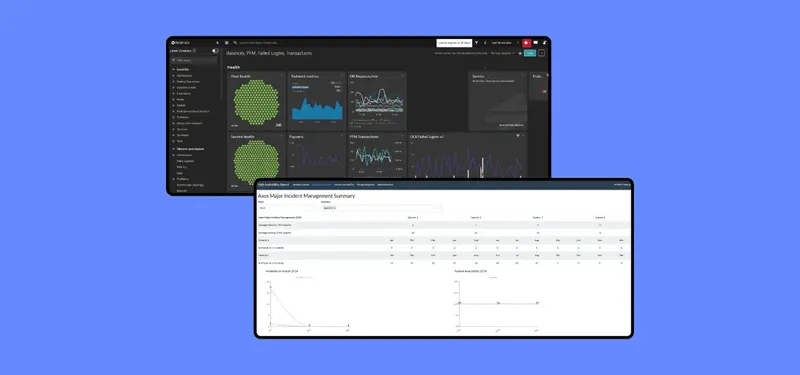
 Full-Scale IT Ops and Security Support for Banking GrowthAxos BankRead case study
 Healthcare
 5 years powering 3,000 to 4,000 device installs a year and acquisition prep.Checked UpRead case study
 Energy & Utilities
 Cloud Infrastructure Modernization for Energy Saving SolutionsLuminanceRead case study
“The company consistently delivers a strong customer experience through high-quality services.”

Let’s talk
Walk us through your stack and environments in a 30-minute call. We come back with an assessment plan and the SLAs we would run to.
People and Projects
People · Trusted nearshore and onshore engineers who work your hours.
Projects · You bring a defined problem and a budget. We fix the scope and the fee, then deliver.
Before you start
A managed services provider runs IT operations on your behalf. Most are reactive: they monitor and respond when something breaks. unosquare is a software engineering company that added managed IT services because clients asked us to run what we built. So we forecast capacity, automate repetitive work, tune performance down to the database query and work in your time zone.
We price in pods, not by the hour. Each pod is staffed to reach the SLAs we agree, with a defined FTE blend, coverage window and SLA scope, so there are no surprise change orders and no per-incident charges. Once the engagement reaches steady state, you pay a known fee each month. The price depends on the complexity of your stack, the number of environments and the coverage you need. The assessment gives you the numbers before you commit.
We staff the team within 2 to 4 weeks. It starts with an assessment, then a NOC rollout. A launch team deploys in weeks 1 to 5, and SLA governance is live by week 15.
We do. Managed IT services work like a dedicated team, but the roadmap is the SLAs we agree and our performance against them. Our team leads run the pods, and you see the results on a monthly green, amber and red dashboard. Your engineers stay on product work. We manage delivery, performance and the engineers, and share performance improvement plans with your leadership when something slips.
Yes. Incident response is part of every managed IT operations engagement. Our team monitors, detects and responds around the clock, from debugging to resolution and the post-mortem. Supporting offshore operations in the Philippines help us staff that 24/7 schedule. Your SLA sets the response commitments and escalation paths, and every P1 produces a permanent-fix ticket. We are accountable for availability and performance, and service credits apply if we miss an SLA.
We are SOC 2 and HIPAA compliant. SecOps runs continuous scanning and routes each finding to development, SRE or network operations, aligned to the SOC 2 and HIPAA requirements your systems carry. Access management automates identity, role-based access and HR-triggered onboarding and offboarding. All IP we create is yours.
Managed IT services work like a dedicated team: our team leads build and run the pods, and we manage delivery and performance. The difference is the roadmap. A dedicated team works to your product roadmap, and managed IT services work to the SLAs you agree, with service credits if we miss one. With staff augmentation, you pick and direct each engineer and manage delivery yourself. With managed IT services, your team manages the least.
In our nearshore hubs across Latin America, covering US Eastern through Pacific, so incidents get same-business-hour response instead of a 3 a.m. bridge call. You can add an onshore account lead for a hybrid model.
Yes. We run managed application services for any system, whoever built it. We start with knowledge transfer: a codebase walkthrough, an architecture review and runbooks. Once we have full context, we move to ongoing operations. The timeline depends on your stack, and we document everything so coverage has no gaps during the handoff.
Yes. With co-managed IT services, you keep the areas you want and we run the rest. Some clients hand us infrastructure and security only, others the full operation. We write the ownership boundaries down upfront, so everyone knows who owns each incident when it matters.
Yes. Moving from a build to managed IT services is one of our most common paths: we deliver the product as a fixed-fee Outcomes project, then run it in production. You do not need managed IT services after a build. If someone else built your system, we take it over through a structured knowledge transfer. You own the system. We run it.
You can buy it on its own or as the first step of a managed IT services engagement. We audit your environment across NOC, SRE, DevOps, change management and SecOps. You leave with a current-state picture, a gap analysis ranked by impact and urgency and a phased roadmap to sustainment.