
The Gap Usually Appears Before the Software Fails
Most companies do not reach for custom software development because their existing tools have stopped working. They reach for it because the business has moved beyond what those tools were designed to support.
The platform still runs. Teams still log in. Reports still get produced. Yet an important business process now depends on work happening around the software rather than inside it. That gap widens as digital transformation reshapes how companies compete and grow.
Consider a company approaching the renewal of a core operations platform. The system handles standard tasks, but customer onboarding still moves through spreadsheets, email approvals, and manual handoffs. Leadership can see each piece of the process, but not the process as a whole.
Renewing the platform would preserve a familiar tool. It would also preserve the operating gap around it.
That is one version of a much broader pattern.
A product leader may be waiting on a customer-facing capability that does not fit the current roadmap. A growth team may have customer data but no practical way to act on it. An AI pilot may have proven its value through machine learning without becoming a production system. A regulated business managing HIPAA-covered workflows, GDPR-protected data, or EHR record requirements may need a process that standard software cannot match closely enough.
The specific applications differ. The decision underneath them is the same: should the business keep adapting itself to available software, or has the missing capability become important enough to build and own?
The Real Question Is Not Build Versus Buy
“Build or buy” sounds like a choice between two types of technology. In practice, it is a choice between two ways of obtaining a business capability.
Off-the-shelf software is built around needs that many companies share. That is its advantage. It can put a proven capability in place quickly without requiring the business to design and maintain the product itself.
Custom software solutions start from a different premise. The business outcome comes first, and the software is designed around the workflows, constraints, and priorities required to produce it.
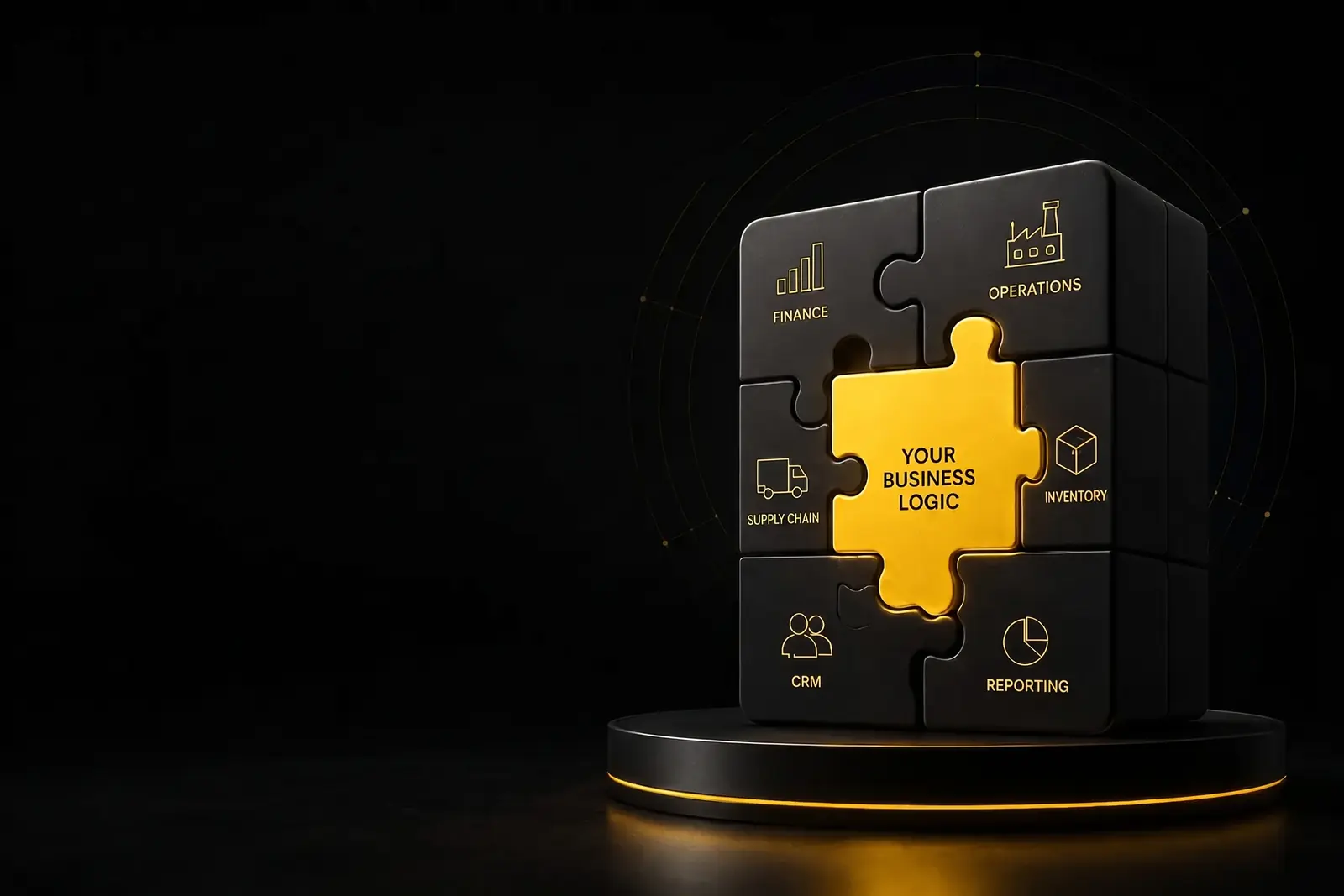
Return to the operations example. The real goal is not to replace a platform. It is to create a reliable path from customer onboarding through approval, delivery, and reporting. The answer could be a new owned application. It could be APIs connecting existing systems. It could also be a better use of tools already licensed, including customer relationship management (CRM) platforms, content management systems (CMS), and the rest of the current stack.
Custom software development is the right answer only when the outcome cannot be reached effectively through configuration or integration alone.
That distinction keeps the decision grounded. The objective is not to build more software. It is to remove a business constraint that standard software leaves in place.
When Custom Development Has the Advantage
Custom software development tends to beat off-the-shelf tools when the missing capability is closely tied to how the company operates, competes, or grows.
The workflow is specific to the business
Standard platforms work best when the company can adopt a standard process. Custom software development becomes more valuable when forcing the business into that process would cost it something real: the customer experience it has built a reputation on, the way the business actually runs, or a control it cannot hand to a vendor.
In the renewal example, the issue is not that the platform lacks features. It is that the complete workflow crosses systems, teams, and decisions that the platform was never meant to coordinate. Workflow automation can address part of this, but only when the underlying logic is too specific to fit a standard product.
The same pattern appears in a media company that needs a specific content and monetization flow, a financial services organization managing a regulated customer process, or a manufacturer coordinating information across ERP systems and operational platforms.
The capability affects a meaningful business outcome
A custom build should be connected to a result leadership actually cares about: reducing manual work, unlocking revenue, moving a machine learning use case into production, closing a product gap, or fulfilling a commitment already made.
Scalability is often part of that. A capability that works at today’s volume must also work when the business grows. Designing for scale from the start is far more efficient than retrofitting it after launch.
That is the difference between software worth owning and a feature wish list. The closer the connection between what gets built and what the business actually needs, the easier it is to judge whether ownership is worth the cost.
Existing tools leave the same gap after configuration and integration
Many software problems should be solved inside the current stack. Configuration is often faster. APIs can preserve investments the company has already made.
Custom software development becomes the better option when those routes still leave the organization with a fragmented process, repeated manual work, or a capability that remains dependent on a vendor’s limitations and priorities.
Legacy software makes this worse. A CRM that cannot connect to a customer portal, or an ERP that requires manual exports to feed analytics, creates the kind of gap that integration alone cannot close cleanly.
Ownership matters beyond the initial launch
Bespoke software gives the company full control over the code, data, and roadmap — provided the contract is set up for it. That control eliminates vendor lock-in: the risk that a product roadmap diverges from the company’s needs, leaving only the options of adapting or migrating.
That matters when the software needs to grow as the business does. A product team can extend it. An operations team can adapt it as the process changes. Leadership is not waiting for another vendor’s release schedule before acting on its own priorities.
Maintenance costs are also more predictable with owned software. The company is not exposed to unilateral price changes, sunset decisions, or licensing structures that grow more expensive as the business scales.
The company has a defined outcome but not the internal capacity to ship it
The need for custom software development does not always come from a lack of ideas. Often the business knows exactly what needs to be built — the internal roadmap is full, a prior build has stalled, or the deadline is closer than the current team can manage.
In that situation, the question is not whether the company could build it eventually.
The question is whether the business can afford to wait.
The Right Answer Gets Clearer When You Can See Both Options
Before deciding whether to build, you should be able to see what a custom build would actually look like for your specific operation. That’s what week one is for: unosquare maps your workflows, identifies the gap, and delivers a working prototype — so the decision is based on something real, not a requirements document. See how the evaluation works.
When Off-the-Shelf Is Still the Better Choice
Custom software should not win by default.
An off-the-shelf platform is usually the stronger choice when the capability is standard, the business can work effectively within the product’s model, and speed to initial adoption matters more than control over the roadmap.
It is also the better answer when configuration or integration can close the gap without creating another layer of unnecessary software.
| Decision factor | Custom software development | Off-the-shelf software |
|---|---|---|
| Best fit | A capability shaped by the company’s specific workflows or strategy | A common business need served well by a standard product |
| Initial path | Requires the outcome to be defined before the build | Can often be adopted and configured quickly |
| Flexibility | Built around the required business process | Limited to the product’s configuration and roadmap |
| Ownership | Client owns the code, data, and roadmap; no vendor lock-in | The vendor controls the product and its future direction |
| Scalability | Designed for the company’s growth trajectory from day one | Limited by the product’s architecture and scaling tiers |
| Long-term value | Strongest when the capability is important enough to evolve and own | Strongest when the need remains standard over time |
The dividing line is not complexity. A complicated process does not automatically require custom software, and a seemingly simple capability may justify a custom build if it is central to the business.
The better test is strategic importance. If the company can buy the outcome, it should. If it can only buy part of the outcome and must keep compensating for the rest, building deserves serious consideration.
What the Renewal Example Really Represents
The software-renewal scenario is useful because it exposes the cost of an unresolved gap.
The company is not choosing between an old product and a new product. It is deciding whether to carry the same constraint into another budget cycle.
For an operations leader, that constraint may be a process held together by manual coordination. For a CPO, it may be a capability customers keep requesting but the roadmap cannot reach. For a CEO, it may be a board commitment that requires a working product rather than another internal initiative. For a growth leader, it may be workflow automation or predictive analytics that exists in fragments but never becomes a usable system.
These are not separate categories of custom software development. They are the same problem showing up in different parts of the business:
- A meaningful outcome has been defined.
- Current tools or internal capacity cannot deliver it in the required window.
- The business must decide whether to keep working around the gap or commission the capability directly.
That is the point at which tailor-made software moves from a technology option to a business decision.
Fixed Fee Only Works When the Outcome Is Defined
A fixed price does not make an unclear project predictable.
The budget can be agreed while the finished result remains open to interpretation. When that happens, the engagement still has no reliable answer to the question that matters most: what exactly will the business receive?
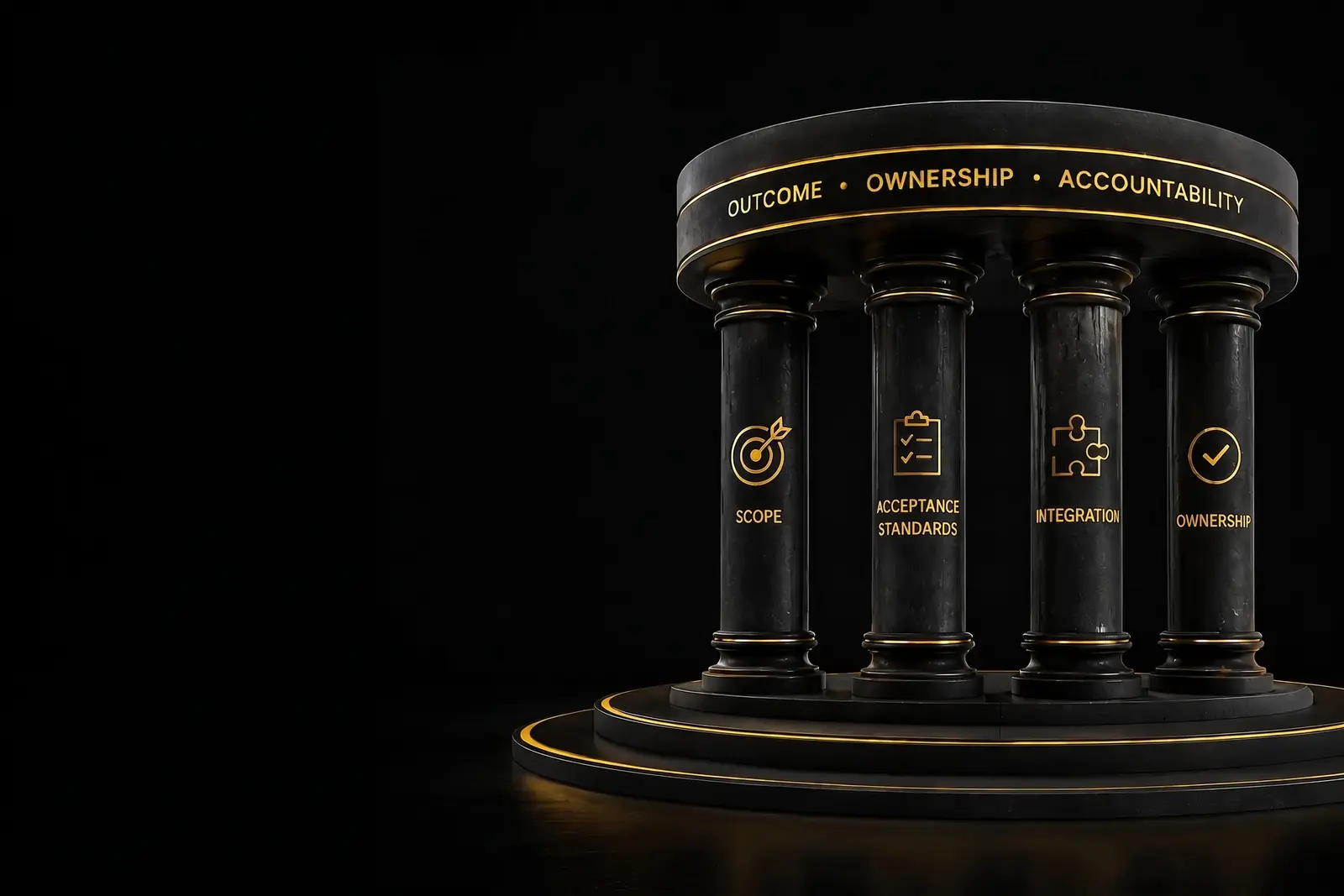
The fix is to define what the software actually needs to do before the build starts. Design and price get locked before development begins, and success is measured by whether the software works — not by how many hours were billed.
For the company in the renewal example, “replace our operations platform” would be too broad. The outcome must describe the working capability the business expects to receive. That could be a production-ready workflow that connects the relevant systems, gives each team a clear role, and returns usable visibility to leadership.
The same discipline applies whether the deliverable is a customer portal, a payment gateway integration, a web application, or a mobile app development project. A development partner earns its value not by writing code, but by turning a business goal into a scoped, buildable product with quality standards agreed before work starts.
The software type changes. The need for a clearly defined result does not.
How unosquare Moves From Idea to Owned Software
unosquare’s Outcomes model moves through four phases, with each phase reducing uncertainty before the next commitment.
Discovery, Week 1
Goals, workflows, and systems are mapped. A working MVP is delivered in the first week, giving leadership something concrete to evaluate before committing to the full build.
In the operations example, the prototype would make the proposed process visible. It gives the company a practical way to judge whether the idea solves the right problem before the design and price are locked.
No commitment beyond Discovery is required.
Solution Architecture, Week 2
The design and price are locked before the build starts.
This turns the prototype into a defined software outcome. Leadership can see what is being commissioned, what it will cost, and what the completed product is expected to do, including scalability targets and quality assurance requirements.
Build, Weeks 3-11
Working software is delivered on a regular cadence, guided by an agile methodology and structured Scrum framework. The architecture is chosen for what the outcome requires: microservices for distributed systems, or a unified platform for simpler deployments. Continuous integration and DevOps tooling are configured for the client’s team to take over from day one.
The company sees the capability take shape while unosquare owns the delivery cadence. The engagement is centered on returning a working product, not on supplying billable capacity.
Deploy and Handoff, Week 12
The software is delivered production-ready, documented, and client-owned, with post-launch support protocols in place.
The client receives full ownership of the code, data, and roadmap. The codebase is built to be maintained and extended, so the delivered capability can continue to evolve with the business.
The full process is designed to ship in 8-12 weeks. Builds start as low as $100K, with the fixed fee scoped before code is written. If delivery takes longer under the fixed-fee scope, the additional cost belongs to unosquare, not the client.
What Leaders Need to Know Before Choosing Custom
The decision becomes easier when leadership can answer four questions.
Is the outcome important enough to own?
Ownership has value when the capability affects how the company earns revenue, serves customers, controls operations, or responds to a strategic mandate. It has less value when the need is standard and likely to remain standard.
Can the current stack produce the outcome without preserving the workaround?
A successful integration is often better than a new application. The relevant question is whether the complete business result can be achieved, including the scalability the business will need as it grows, not whether the existing software can be made to do more.
Is the company prepared to define the result clearly?
Custom software development becomes more predictable when leadership can describe the capability in business terms. What should change once the software is in production? What work should disappear? What should customers, employees, or decision-makers be able to do that they cannot do today?
Does the delivery model end in ownership?
A custom build should leave the company with a production-ready product it can run, maintain, and extend. The value is not simply receiving software. It is receiving the capability without creating permanent vendor dependency.
Proof That the Model Can Support Enterprise Use
unosquare brings 16 years of engineering discipline and more than 2,500 completed projects to the Outcomes model. Its client NPS ranks in the top 1% of B2B services, with enterprise experience across regulated industries. As the custom software development market matures, the firms that consistently deliver are those that lock scope, price, and a clear description of what done looks like — before code starts.
Axos Bank runs a platform built through a full mobile app development program covering iOS, Android, and web, serving more than 105,000 monthly active users with 99.9% uptime.
Software is penetration-tested and SOC 2 compliant before launch. HIPAA and GDPR requirements are addressed where the client’s industry demands it.
The architecture is designed for real load and scalability from day one. CRM integrations, CMS deployments, and APIs connecting third-party platforms are all documented for the client’s team to maintain and extend.
These proof points matter because the objective is not a persuasive demonstration.
It is working software that can operate inside the business.
The Point at Which Custom Software Becomes the Better Bet
Custom software development beats off-the-shelf tools when the business cannot purchase the complete outcome it needs.
That moment may arrive during a software renewal, but it can just as easily appear when an internal build stalls, an AI pilot needs to reach production, a product roadmap cannot absorb a priority, or a fragmented process begins limiting growth.
The specific trigger matters less than the pattern. The company has a defined capability to ship, the existing route cannot deliver it effectively, and ownership has become more valuable than another workaround.
For the operations leader in the original example, the decision is no longer simply whether to renew a platform. It is whether to continue paying around the same constraint or use that moment to create the capability the business actually needs.
That is the role custom software solutions should play: not a replacement for products that already work, but a direct path to a business outcome the market cannot provide in ready-made form.
See It Working. Then Decide.
You don’t have to choose based on a proposal. unosquare delivers a working prototype in week one — before the design, price, or full scope is locked. If it’s right, the full build follows on a fixed fee. If it isn’t, you walk away with a working proof of concept. No commitment required. See how the build process is structured.
Frequently Asked Questions
When does custom-built software make more sense than off-the-shelf software?
Custom software is the better call when the capability is specific to how the business operates, tied to a result that actually matters, and can’t be reached through reasonable configuration or integration of existing tools.
Off-the-shelf software stays the better option when the need is standard and the business can adopt the product without having to build workarounds into the process.
Does choosing custom software mean replacing our current systems?
Not necessarily. A custom solution can replace a system, connect existing tools via APIs, or add a capability the current stack does not provide.
The decision should start with the outcome and the company’s existing investments, whether that includes a CRM platform, a content management system, or other licensed tools, not with the assumption that everything must be rebuilt.
How does unosquare make a fixed-fee custom build predictable?
unosquare maps the goals, workflows, and systems during Discovery, delivers a working MVP in week one, and locks the design and price in week two before the build starts.
Everything is built around a clear picture of what the software needs to do. If delivery takes longer under the fixed-fee scope, the additional cost is unosquare’s responsibility.
What does the client own after handoff?
The client receives full ownership of the code, data, and roadmap. The software is delivered production-ready and documented, with a codebase designed to be maintained and extended. Post-launch support protocols are in place before handoff, and the team can run and evolve the product independently.
How quickly can custom-built software be delivered?
unosquare’s Outcomes model is designed to move from Discovery through deployment and handoff in 8-12 weeks. A working prototype is delivered in week one, and builds start as low as $100K, scoped before code is written.
References
-
Deloitte. (2026). Tech trends 2026. https://mkto.deloitte.com/rs/712-CNF-326/images/DI_Tech-trends-2026.pdf
-
Deloitte. (2026). SaaS meets AI agents. https://www.deloitte.com/us/en/insights/industry/technology/technology-media-and-telecom-predictions/2026/saas-ai-agents.html
-
Forrester Research. (2013, September 4). Key considerations for SaaS sourcing. https://www.forrester.com/blogs/09-04-13-key_considerations_for_saas_sourcing/
-
Google Cloud. (2025). DORA report: State of AI-assisted software development. https://dora.dev/research/2025/dora-report/
-
National Institute of Standards and Technology. (2023). Artificial Intelligence Risk Management Framework (AI RMF 1.0). U.S. Department of Commerce. https://www.nist.gov/publications/artificial-intelligence-risk-management-framework-ai-rmf-10
-
Office of the National Coordinator for Health Information Technology. (n.d.). Certification of health IT. U.S. Department of Health and Human Services. https://healthit.gov/certification-health-it/
-
OWASP Foundation. (n.d.). OWASP Web Security Testing Guide. https://owasp.org/www-project-web-security-testing-guide/
-
Regulation (EU) 2016/679 of the European Parliament and of the Council of 27 April 2016 on the protection of natural persons with regard to the processing of personal data and on the free movement of such data (General Data Protection Regulation). Official Journal of the European Union. https://eur-lex.europa.eu/eli/reg/2016/679/oj/eng
-
U.S. Department of Health and Human Services. (n.d.). HIPAA security rule. https://www.hhs.gov/hipaa/for-professionals/security/index.html
-
Association of International Certified Professional Accountants. (n.d.). SOC 2® — SOC for service organizations: Trust services criteria. https://www.aicpa-cima.com/topic/audit-assurance/audit-and-assurance-greater-than-soc-2
Our Editorial Standards
Our content is developed by combining original industry research, analysis from our senior technical team, and the assistance of AI tools. We prioritize accuracy, practicality, and value for our readers, drawing on decades of hands-on software development and delivery experience to translate complex technology concepts into actionable insights.
Important Disclaimer
The information in this article is provided for general informational purposes only and reflects insights available as of the publication date. It does not constitute professional, legal, or compliance advice. Organizations should consult with qualified professionals before making decisions based on the content of this article.

Oscar Rank
Head of Marketing
Oscar Rank is the Head of Marketing at unosquare. He arrived there after a 15-plus year career spanning financial services, retail and technology. His path ran through product management, strategy, data and CRM roles before he made the jump into full-funnel marketing and GTM. He holds a degree in industrial engineering from the University of Toronto, with a specialization in human factors. That systems-first, human-centered mindset shows up in how he runs marketing: build the process, then let the data settle the argument. He writes about how software and AI are changing what’s possible for a business, and how that shifts the trade-offs leaders have to make.