
The hard question lands in a war room or an audit kickoff:
Can you open dated, named proof of approvals, monitoring ownership, and live controls right now, without rebuilding the story from email threads overnight?
Most teams already have policies, model notes, and a shared drive full of slides. What they lack under pressure is the live record: who approved this system, who owns monitoring today, and which controls are running right now.
The war room does not wait for a binder. Someone opens the record while everyone is still in the room, or the program fails the moment scrutiny arrives. That is why the first filter for AI governance is three pull tests, not another policy rewrite.
Three Pull Tests
You do not need a long questionnaire to know whether AI governance is real. Three questions usually settle it:
- Can you open a dated approval record, with a named reviewer, for any model in production?
- Do you have a current list of every AI system you are running right now, each with a named person who owns monitoring?
- Can that person open the live controls and monitoring tools in the room when a board member or auditor asks?
If you cannot answer all three while everyone is still in the room, AI governance is documentation, not an operating system. Named monitoring ownership is accountability in practice: someone who can open the live record, not a title on a slide.
unosquare treats those three tests as the starting design brief. The build is scoped to produce the records, not to describe them. A fixed fee only helps once those records are written into the agreement.
Why Fixed Pricing Alone Does Not Make Governance Pullable
A fixed fee caps what you spend. It does not define what someone must open when the board asks. Finance can celebrate the number. Compliance still inherits whatever evidence the contract actually requires.
So put both in the agreement before code starts: the fee, and pass/fail criteria for the three pull tests (dated approvals, named monitoring owners, and live control snapshots someone can open in the room). Then the fee buys AI governance you can show under scrutiny, not a binder assembled overnight.
unosquare maps those board questions to deliverables in Discovery and Solution Architecture, before the build budget is committed. Once the fee covers those records, the next step is putting the exact board questions into scope.
What the Board Will Ask Under Scrutiny
A fixed fee with pull-test criteria still needs a concrete evidence map. Boards and auditors do not need framework acronyms. They need transparency they can open: dated answers, named owners, and live controls. Put these questions in scope before code starts:
| Board question | Evidence you must open | When it must exist |
|---|---|---|
| Who approved this AI system for this use? | Dated approval record with a named signer | Before production launch |
| Who owns monitoring today? | Named monitoring owner attached to each live system | At go-live and kept current |
| Which controls are running right now? | Live control snapshot someone can open in the room | At go-live; refreshable on demand |
| Can we show how risk was assessed? | Written risk list mapped to the business use case | Before acceptance |
| Can we prove the system was tested for unfair outcomes where people are affected? | Documented fairness-check results for relevant models | At each deployment milestone |
| Can we retrieve the record after the partner leaves? | Retention rules and accessible records of what happened and when | Written before handoff; verified at handoff |
The same bar shows up across the major frameworks. The European Union’s AI Act{1} (often shortened to the EU AI Act) rules for higher-risk AI, NIST AI Risk Management Framework{2} (NIST AI RMF) guidance, and ISO/IEC 42001{3} management-system expectations all ask for proof you can open, not a binder.
OECD AI Principles{4} and GDPR{5} add the same pressure wherever data privacy or high-risk processing is in play. Responsible AI programs that cannot open this proof fail the same board test as weak regulatory compliance. Under ISO/IEC 42001, that bar is still the pull test: records someone can retrieve on demand.
Every row above becomes a deliverable unosquare writes into scope and acceptance criteria before build begins. Those records stay usable after handoff only when five scope points are locked before code starts. PROVE is that lock.
PROVE: Five Points That Make Evidence Pullable
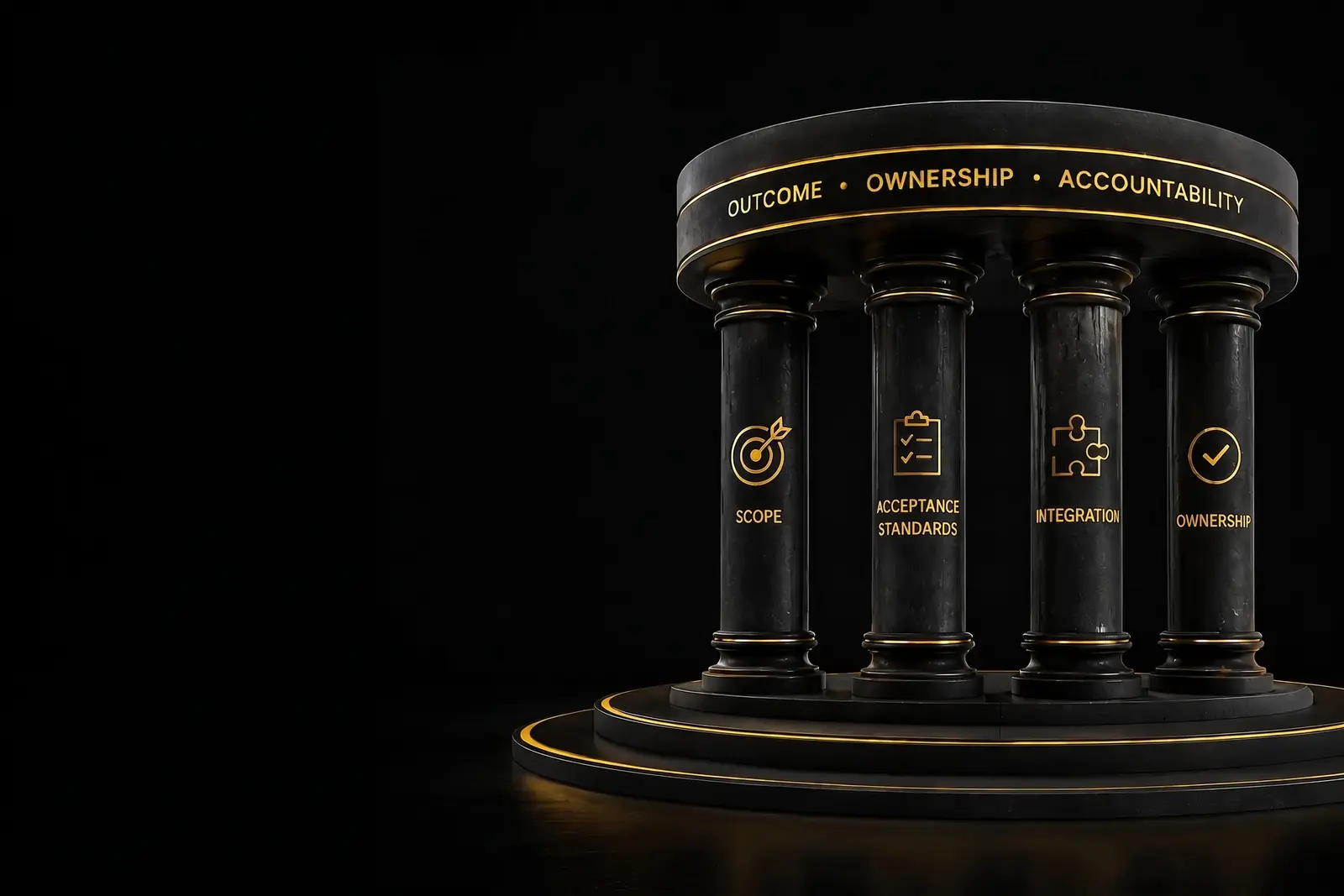
The board questions name what someone must open. PROVE turns those questions into records that still open after handoff. unosquare builds these five points into every engagement before code starts, so AI governance holds across the full AI lifecycle from discovery through handoff:
- P: production commitment
- R: rights and ownership
- O: operational evidence
- V: verified automation
- E: exit operational guides with retention
Each belongs in the agreement from day one and is produced from Discovery through handoff.
| Letter | Business meaning | What shows up in the deal | Pull-test evidence |
|---|---|---|---|
| P | Production commitment | Fixed pricing tied to production-ready pass/fail checks; formal change-order process; in-scope overrun on unosquare | Milestones release only when criteria prove the system operates, produces evidence, and transfers cleanly |
| R | Rights and ownership | Written ownership of the software and intellectual property (or escrow); handover plan for code folders, launch settings, and who can log in; third-party license disclosure | Your team opens the code, settings, and logins without calling the partner after handoff |
| O | Operational evidence | Dated approvals with named reviewers; monitoring ownership maps; risk assessment records; live control snapshots; data lineage (a clear map of where data came from and how it moved); fairness checks where people are affected; and record retention with audit trails that support traceability (the ability to follow what happened and when) | Under pressure: open the approval trail, name the monitoring owner, and show active controls in the room without rebuilding the story from email threads |
| V | Verified automation | Ongoing policy checks, automatic logging, a current system list, and monitoring with named owners | At least one control runs on its own (no one clicking through it) while stakeholders watch |
| E | Exit operational guides and retention | Post-launch support with named responsibilities; incident response and update guides; audit log retention verified after partner exit | Your team passes the war room pull test without unosquare present |
The operational record is the deliverable: who approved, who owns monitoring today, what is running, and when it was last checked. That is transparency and accountability you can demonstrate in the room.
Explainability packs and “why this prediction” dashboards answer a different question. That is model storytelling, not AI governance evidence you can pull on demand. Explainability without dated approvals and named owners still fails the pull test.
Fairness checks and bias mitigation (steps that reduce unfair treatment across groups) still belong in the same package wherever AI affects hiring, lending, clinical routing, eligibility, or prioritization. The FTC has warned companies to test algorithms{6} before use and periodically afterward for unfair outcomes across groups, which is why bias audits belong in the same evidence pack as dated approvals.
Generative AI systems{7} and large language models (LLMs) that produce outputs without a person approving each one need continuous oversight, including checks for hallucinations (made-up or unsupported answers).
Agentic AI that takes multi-step actions without a human in every loop needs the same guardrails and oversight mechanisms, recorded as live controls someone can open. A wrong answer or a quiet rule that never fired is a live production event, not a quarterly checklist item.
That gate shows up first in high-volume workflows. Prior-authorization at scale is the clearest example.
Run the Pull Test Before You Scale the Pilot
If the war room still reaches for a binder when someone asks who approved the system, a go-wider mandate will not fix that. In week one, a prototype scoped to your pull tests shows whether dated approvals, monitoring ownership, and live controls can open on demand, before any build budget is committed.
Prior Auth at Scale, and the Same Gate Everywhere Else
A health plan is preparing to scale an AI system that routes prior-authorization requests (the approvals clinicians need before a procedure or service). The pilot already works, yet the queue is still the bottleneck. Leadership wants broader production this quarter, and the board expects a clear AI progress story.
Before that expansion, compliance and operations need the three pull-test answers inside the build, not as a side project after the fact. Teams that scale cleanly write those AI governance answers into acceptance criteria before the build is priced. The go-wider decision then rests on openable proof, not a promise to catch up later.
Product leaders (CPOs) hit the same gate when a ready roadmap waits on production sign-off. Growth leaders hit it when counsel blocks a personalization or campaign tool until the same records exist inside delivery.
Prior-authorization routing is one instance. The gate is the same wherever AI moves from pilot to production under board or regulatory scrutiny. The week-by-week plan shows how PROVE turns that stuck go-wider decision into records someone can open in the room.
How unosquare Structures Fixed-Fee AI Governance Delivery
The prior-auth queue is still the bottleneck, and the war room still has no openable answer. Every unosquare delivery phase maps to a PROVE checkpoint so evidence is produced during delivery and the pull test is passable before the partner exits.
Discovery: Week One
Week one answers one question for the go-wider case above: which of the three pull tests can you pass today, and which ones will still fail in a board war room tomorrow? unosquare lists every AI system in scope and runs those tests against live records, not policy binders.
Systems already in production without formal controls, including shadow AI (tools teams adopted outside approved channels), surface here and enter scope as named deliverables. You leave with a signed evaluation plan, named approval authority, and a baseline score that shows which evidence gaps the build must close before go-live.
What this phase delivers: a pull-test gap map tied to production acceptance checks (PROVE: P).
Solution Architecture: Week Two
Every row in the board scrutiny table becomes a pass/fail test with a named evidence deliverable before pricing locks. unosquare maps each requirement to the record someone must open under scrutiny: dated approvals, monitoring ownership by system, live control snapshots, retention rules, and handover access.
Security approvals and access controls are documented so those records stay openable after the partner exits, including how the build handles PII (personally identifiable information) and how live controls respond to security threats. Builds start as low as $100K, with pull-test acceptance criteria and named evidence deliverables signed before code starts.
What this phase delivers: a signed map from each requirement to the evidence your team can use to settle any auditor question before code starts (PROVE: R and O).
Build: Weeks 3-11
AI governance evidence is built during delivery, then stress-tested in the room. At each milestone, someone opens the live approval trail, names the monitoring owner for each system on the list, and shows at least one control running on its own (no manual click-through) while stakeholders watch.
Data quality checks, documented fairness-check results for relevant machine learning models, and ongoing risk assessment produce records you can export at every gate, not slide decks filed afterward. Access controls on those evidence packages stay part of the same milestone check.
What this phase delivers: milestone evidence packages that survive an in-room pull test (PROVE: V).
Deploy and Handoff: Week 12
Handoff is complete when your team passes the war room test without unosquare present. A board member or auditor asks for approvals, monitoring ownership, and live controls. Your named owner opens them from the operational record, which is how accountability stays visible after handoff.
Three post-handover metrics confirm the transition: time to independent deployment, average time to resolve governance issues, and your team’s signed validation of the operational guides. Exit guides, retention rules, and recorded knowledge-transfer sessions keep that evidence openable after the delivery partner leaves.
What this phase delivers: a partner-independent pull test and signed exit operational guides your team can run on its own (PROVE: E).
unosquare has completed more than 2,500 projects over 16 years, with a client NPS in the top 1% of B2B services and enterprise clients across financial services, healthcare, and other regulated industries.
Deliveries are security-tested before launch, meet SOC 2 controls, and follow HIPAA-ready practices where health data rules apply. Cloud partner credentials (AWS, Azure, Databricks) back the systems where those builds run.
Once the path is clear, the remaining filter is whether your organization can commit to pull-test acceptance criteria now.
Readiness Check: Is Now the Right Time?
An AI governance build only pays off when the organization can commit to pull-test acceptance criteria and a named sponsor before code starts. Three questions settle fit:
- Is there a named executive sponsor with authority to approve scope and acceptance criteria?
- Is there a regulatory deadline, audit window, or board commitment creating a clear timeline?
- Can you name the use case and the pull tests that must pass before production sign-off?
If the answer to all three is yes, the conditions for a productive fixed-fee engagement are in place.
| Profile | Typical Situation | What They Need From AI Governance |
|---|---|---|
| CEO/COO | Board AI deadline, investor expectations | Evidence you can open, defined ownership, timeline certainty |
| CPO | Roadmap blocked pending production sign-off | Governance evidence for approvals, owners, and live controls |
| CMO/Growth | Campaign or martech AI blocked pending production sign-off | Governance evidence you can open for approvals, owners, and live controls |
| Compliance Lead | Upcoming review or regulatory preparation | Clear record of where evidence came from, retention rules, automatic controls |
Compliance deadlines, SaaS renewals that need integrated controls, and production deployments with tight timelines usually define when onboarding starts.
If you recognize your row in that table and the three questions above are yes, the remaining objections are usually about engagement mechanics, not the pull-test bar itself.
What Executives Ask Before Committing
Before the prototype, executives usually want the engagement mechanics settled. These are the questions that come up most often once pull-test acceptance criteria are on the table.
| Question | Short Answer |
|---|---|
| How does fixed-fee work if we need scope changes? | The change-order process is defined before build starts. Changes are tracked and priced in the open. |
| We’ve had mixed experiences with outside partners. How is this structured differently? | Payment is tied to production-ready pass/fail checks, not deliverable sign-offs alone. The outcome is written into scope before code starts. If in-scope work runs long, that overrun is unosquare‘s cost. |
| We don’t have bandwidth to manage this. | unosquare owns the delivery schedule. A named sponsor is enough to keep decisions moving. |
| What if our data isn’t ready? | Discovery surfaces data gaps in week one. The prototype confirms feasibility before any build commitment. |
| We’d rather build in-house. | The prototype phase clarifies whether internal capacity can deliver within the regulatory timeline. |
What the Prototype Proves
The free prototype is a one-week validation that runs the three pull tests against your live records. It confirms three things: the AI governance use case is operationally feasible, the team agrees on pull-test acceptance criteria, and unosquare can produce checkable evidence on an agreed timeline.
You leave with a pre-production demo, an acceptance criteria document, and a fixed-fee estimate for full delivery. Three milestones follow: prototype completion and executive review, formal acceptance and Statement of Work freeze, then a confirmed fixed-fee build start date. The first call sets expectations for all three.
Bring a brief use case summary, key internal contacts, and any compliance deadlines. That usually makes the week productive.
Once the prototype path is clear, the last check is honest status against the three pull tests today.
Where You Stand Before the Build Starts
If your AI governance documentation cannot yet pass the three pull tests, unosquare maps those gaps in week one and turns them into a scoped, checkable governance build plan before any build commitment. See the week-one scoping process and how a fixed-fee governance build runs from day one.
Week One Makes the Evidence Trail Visible
Week one runs the same pull tests the board will run later, before any build budget is committed. unosquare shows which records you can open today, which gaps block scrutiny, and what a fixed-fee estimate looks like with no commitment required. See what a week-one AI governance scoping produces.
FAQ
Once pull-test evidence is in scope, the remaining questions are usually about ethics versus operations, board evidence, and what the prototype actually proves.
What is the difference between AI governance, AI ethics, and AI regulation?
Governance is operational: controls, evidence, and accountability built into how the system runs. AI ethics defines principles and policy intent. Regulation sets the enforceable minimum.
Ethical guidelines and ethical considerations belong in the policy layer; they become responsible AI in practice only when the three pull tests pass.
Boards need operational AI governance evidence they can open under scrutiny. A complete engagement produces checkable records alongside the policy framework, so ethics intent and governance evidence both show up in the same build. Transparency without openable records is still a slide deck.
What evidence should boards look for before approving compliance work?
Boards should expect clear markers on all records. That means dates, who reviewed them, and which production system the record belongs to: transparency the room can verify.
They should also expect proof that logging happens automatically; a mapping that links deliverables to regulatory duties such as EU AI Act obligations for organizations that put high-risk AI into use{8}; and a live demo of at least one control that runs on its own.
unosquare uses that same bar when scoping week-one evidence requirements, so those records are part of delivery rather than assembled after go-live.
How do I verify that ownership of code and deployment assets actually transfers?
Ask for a documented handover plan before you sign. Confirm in a controlled demo that your team can open the code folders and launch settings before final payment.
Confirm that ownership paperwork (assignment or escrow) covers everything delivered, including outside components the build depends on.
unosquare writes that handover plan into the engagement so ownership is clear at every milestone, not only at the end.
How long does fixed-fee AI governance delivery take?
Discovery and architecture wrap by the end of week two. The build phase typically runs through weeks 3-11, with deployment and handoff in week 12. Total timeline from first call to production handoff is typically 8-12 weeks, depending on scope, documentation needs, and internal approvals.
How do we move from an AI pilot to production software?
The path from a working pilot to production AI is mostly a pull-test standard. The system must run reliably, produce records you can open under scrutiny, meet regulatory requirements, and stay maintainable after handoff.
A one-week prototype defines what “production-ready” means for your specific AI system. That scope determines the fixed-fee estimate and the acceptance criteria for the full build.
When AI governance has to hold up under board, compliance, and audit scrutiny, write into scope what you must open before the build is priced. That means approvals, monitoring ownership, and controls.
unosquare‘s fixed-fee outcome-based delivery builds those controls, acceptance criteria, ownership, and handoff path into delivery before code starts, then gives you a week-one prototype so you can see evidence-on-demand delivery in practice.
References
- AI Act Service Desk. (2024). Annex III. AI Act Service Desk.
https://ai-act-service-desk.ec.europa.eu/en/ai-act/annex-3 - Tabassi, E. (2023). Artificial Intelligence Risk Management Framework (AI RMF 1.0). NIST.
https://www.nist.gov/publications/artificial-intelligence-risk-management-framework-ai-rmf-10 - International Organization for Standardization. (2023). ISO/IEC 42001:2023 – AI management systems. ISO.
https://www.iso.org/standard/42001 - OECD. (2024). AI principles. OECD.
https://www.oecd.org/en/topics/ai-principles.html - European Union. (2016). Article 35: Data protection impact assessment. Legislation.gov.uk.
https://www.legislation.gov.uk/eur/2016/679/article-35/2020-01-31 - Federal Trade Commission. (2020). Using artificial intelligence and algorithms. FTC.
https://www.ftc.gov/business-guidance/blog/2020/04/using-artificial-intelligence-algorithms - Autio, C., Schwartz, R., Dunietz, J., Jain, S., Stanley, M., Tabassi, E., Hall, P., & Roberts, K. (2024). Artificial Intelligence Risk Management Framework: Generative Artificial Intelligence Profile. NIST.
https://www.nist.gov/publications/artificial-intelligence-risk-management-framework-generative-artificial-intelligence - AI Act Service Desk. (2024). Article 26: Obligations of deployers of high-risk AI systems. AI Act Service Desk.
https://ai-act-service-desk.ec.europa.eu/en/ai-act/article-26
Our Editorial Standards
unosquare is committed to accurate, well-researched B2B software delivery information. Our editorial team reviews all content for accuracy and relies on reputable sources including industry analysts, technology standards bodies, academic institutions, peer-reviewed research, and established enterprise software providers. All references are checked for accessibility and relevance at the time of publication.
We aim for accuracy in everything we publish, but mistakes can happen and information can age as delivery models, pricing benchmarks, and technology standards change. If you notice an error or outdated information, please contact us so we can review and update our content.
Important Disclaimer
The information provided on this website is for general informational and educational purposes only. It is not intended as, and should not be interpreted as, professional legal, financial, or technical implementation advice. Always consult with qualified technology advisors, legal counsel, or appropriate professionals before making decisions about software investments, vendor selection, or delivery models. unosquare does not assume liability for actions taken based on the information presented on this site.

Oscar Rank
Head of Marketing
Oscar Rank is the Head of Marketing at unosquare. He arrived there after a 15-plus year career spanning financial services, retail and technology. His path ran through product management, strategy, data and CRM roles before he made the jump into full-funnel marketing and GTM. He holds a degree in industrial engineering from the University of Toronto, with a specialization in human factors. That systems-first, human-centered mindset shows up in how he runs marketing: build the process, then let the data settle the argument. He writes about how software and AI are changing what’s possible for a business, and how that shifts the trade-offs leaders have to make.