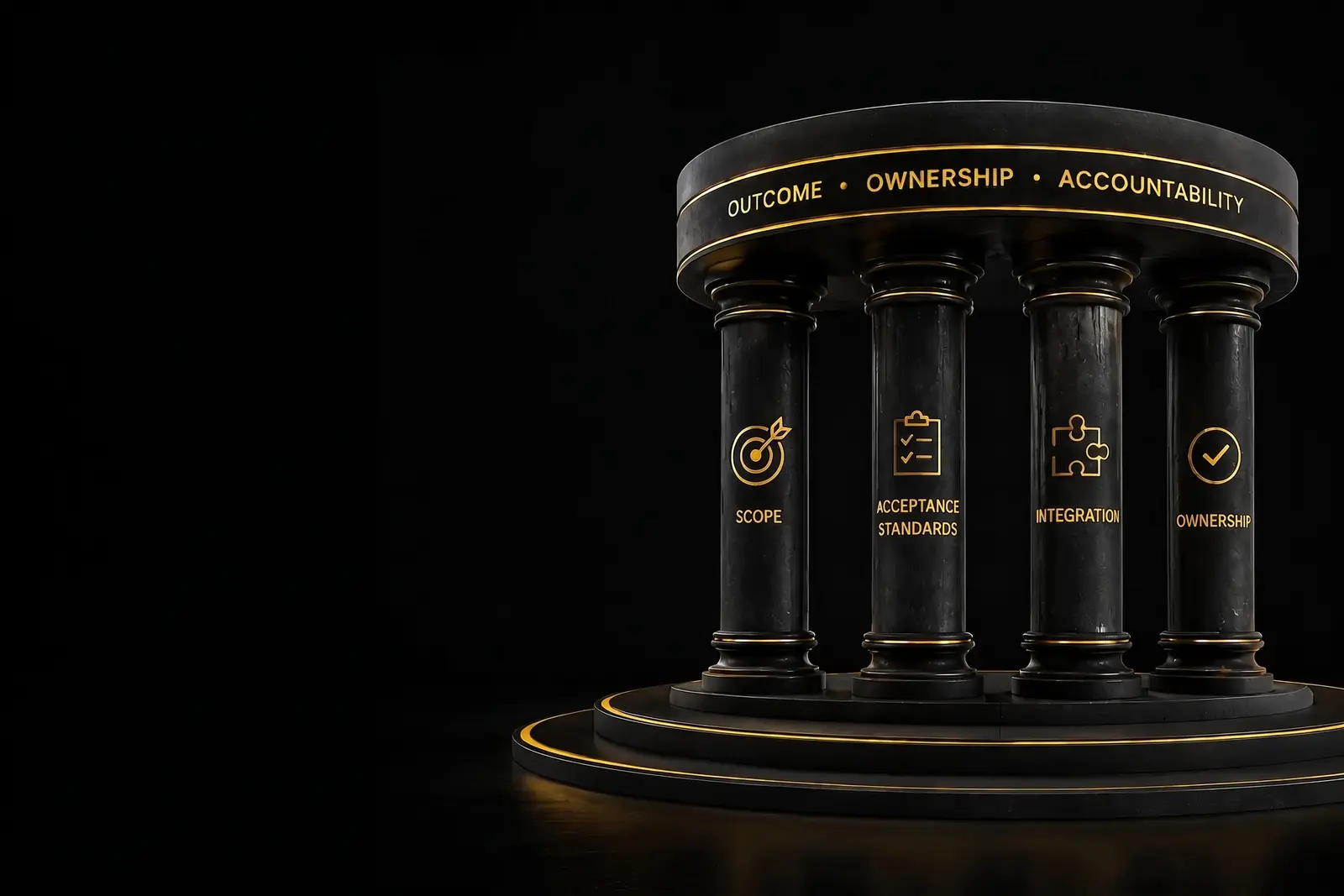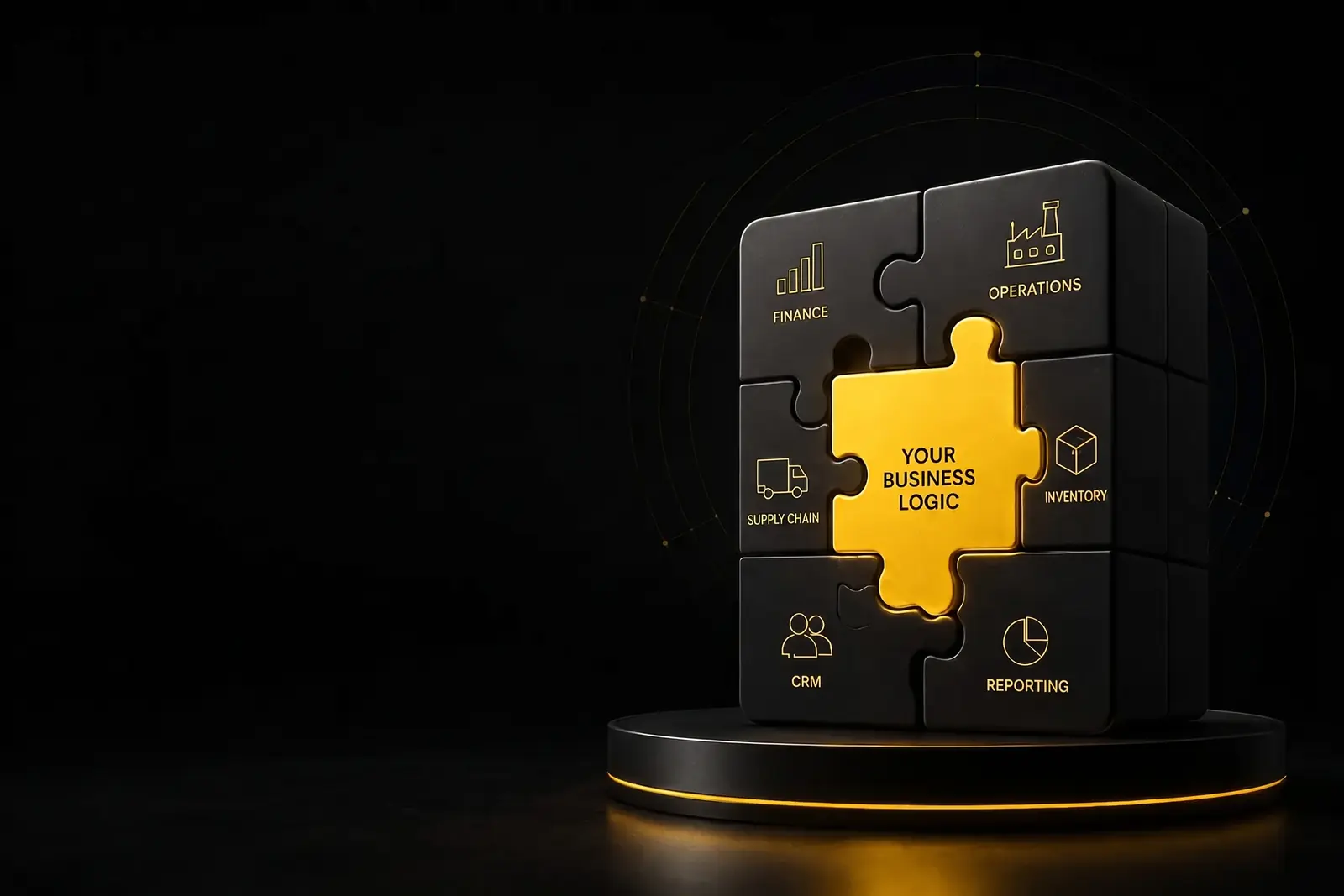

A scaleup rarely has one software problem. It has a backlog of them.
The customer portal needs work. Operations still depends on spreadsheets. Finance is reconciling data across systems.
The product roadmap includes an AI capability leadership wants in market this quarter. Meanwhile, the internal team is already committed to the features customers are waiting for.
The hard question is not whether custom software development could help. It is what to build first.
The best first build is usually not the largest idea or the most visible feature. It is the smallest owned capability that removes a recurring constraint on growth and enables the business to scale up without adding proportional overhead. That could mean accelerating customer onboarding, business process automation that replaces a recurring manual workflow, moving an artificial intelligence (AI) or machine learning pilot into production, or connecting systems that no longer keep up with the business.
For a scaleup, the first build should make growth easier to absorb rather than creating another platform the company has to manage.
Growth exposes the gaps between your systems
Early in a company’s growth, people compensate for missing software.
A sales leader messages operations when a contract closes. Someone copies customer information into a spreadsheet. Product provisions the account manually. Finance enters the same details again for billing. Support keeps a separate checklist to make sure nothing was missed.
The process works because a small group of experienced people knows how to keep it moving.
Then volume increases. Larger customers expect more control, more visibility, and faster execution. New employees do not know the unwritten steps. Exceptions become common.
Leadership can see revenue growing, but the work required to support that revenue grows just as quickly. This is what makes it so difficult to scale up without compounding the operational burden.
At that point, the scaleup may appear to have several separate software needs:
- A customer portal
- Better internal reporting
- Workflow automation
- A CRM replacement
- An AI assistant
- A new data platform
But those requests may all be symptoms of the same business constraint. The company cannot move a customer from signed contract to delivered value through one reliable process.
That is the level at which the first build should be chosen.
What should a scaleup build first?
Build the capability that growth keeps making more expensive, slower, or harder to control.
A useful first build usually has four characteristics:
- It is tied to a business result leadership already cares about. It affects revenue, delivery capacity, operating cost, customer experience, or risk.
- The problem repeats. The team is not solving a one-time exception. It is working around the same limitation every week.
- More growth makes the problem worse. Additional customers, transactions, campaigns, locations, or employees add more manual work, not more output.
- The outcome can be defined clearly. Leadership can describe what the software must allow the business to do when it is finished.
This keeps the decision grounded in business value rather than technology preference.
“Build an AI platform” is too broad to commission responsibly.
“Allow account managers to turn approved client data into a completed renewal recommendation without assembling information manually” is a defined business capability.
“Replace our operations stack” is equally broad.
“Move a new customer from signed agreement to active account through one controlled workflow, with status visible to sales, operations, finance, and support” gives the build a practical boundary.
The second statement is not less ambitious.
It is specific enough to ship.
Start with the bottleneck between demand and delivery
Consider a scaleup that has begun winning larger customers.
Sales can close the deals. The product can support the core use case. The constraint appears after signature.
Customer details arrive through email and the sales system. Operations puts together a plan in a spreadsheet. Product receives a separate request to configure the account.
Finance waits for the information needed to begin billing. The customer asks sales for an update because no one view shows where customer onboarding stands.
The immediate temptation may be to commission a full customer portal, replace the CRM, or rebuild the company’s internal systems around a new data platform.
The better first question is: What capability would remove the constraint now?
The answer may be an owned onboarding workflow that connects the systems already in place through seamless integration, guides each team through the required steps, and gives the customer and every team internally a clear view of progress.
Before that capability exists, each new customer adds coordination work.
After it exists, the scaleup has a repeatable path from closed revenue to an active customer. The same people can manage more volume with fewer handoffs, and the business can scale up without creating equivalent coordination overhead. Leadership gains a clearer view of where delivery is slowing down.
The first build does not need to replace every system involved. It needs to make the business process work as one system.
The same pattern appears in different forms across scaleups:
- A healthcare company may need to move patient or provider intake out of email and disconnected forms into one controlled workflow, with HIPAA compliance and broader security and compliance requirements designed into the process from the start.
- A manufacturer may need a dealer portal that replaces manual order entry and gives customers visibility without replacing the entire back-office tech stack.
- A media business may need to connect content requests, rights approvals, and publishing status so growth does not increase coordination at the same rate.
- A professional services firm may need to standardize client intake, document collection, and internal approvals before adding another point solution.
- A growth team may need an AI-enabled campaign workflow in production, not another isolated pilot that employees cannot use in their daily work.
These are different custom software development builds, but the decision principle is the same: remove the recurring constraint that sits between demand and execution.
Not Sure Which Build to Start With? Week One Answers That.
If you can name a growth constraint but haven’t locked what to build first, that’s exactly what Discovery is for. unosquare maps the bottleneck, scopes the smallest capable build, and delivers a working prototype — before you’ve committed to anything. See how unosquare helps scaleups find and ship the right first build.
Do not begin with the biggest possible platform
Scaleups often wait too long to address an operational constraint because the proposed solution becomes too large.
A broken workflow turns into a plan to replace the CRM instead of a smaller digital innovation step. A reporting gap becomes a company-wide digital transformation initiative. A useful internal AI experiment becomes a proposal for an enterprise platform.
The larger vision may eventually be justified.
It still does not have to be the first build.
The first custom software development project should create a complete, usable outcome while leaving room to extend it later. That could mean building the workflow that sits across existing tools, modernizing one high-value part of a legacy system, or turning one proven AI use case into software that can operate under real business conditions.
When the first build succeeds, scalability follows from a clear foundation rather than from an attempt to overhaul everything at once.
This matters because a scaleup is making two decisions at once:
- Which capability deserves investment now?
- Can that capability be delivered (whether through internal development or custom software outsourcing) without distracting the internal team from the roadmap already supporting growth?
A well-scoped first build answers both. It delivers something the business can use, while the company retains full ownership of the code, data, and roadmap.
Define the outcome before choosing the software
A scaleup is ready to commission a custom software development project when it can describe the result in business terms.
The outcome should identify who needs the capability, what they must be able to do, and what changes once the software is in production.
For example:
| Broad request | Defined outcome |
|---|---|
| Build a customer portal | Customers can submit required information, see onboarding status, and complete outstanding steps without relying on email updates. |
| Automate operations | Operations can process a standard request from intake through approval without re-entering information across systems. |
| Add AI to the product | A defined user can complete a specific task with AI support inside the production workflow. |
| Modernize reporting | Leadership can view the agreed operating metrics from connected source systems without manual reconciliation. |
| Replace legacy software | The business can complete the priority workflow in a maintainable, client-owned application. |
This definition creates a practical boundary around the first build. It also gives leadership a better way to evaluate whether the proposed custom software development investment is worth funding.
The question is no longer, “Do we need custom software development?”
It becomes, “Is this capability valuable enough to own, and can we define what finished looks like?”
A fixed fee is not the same as a fixed outcome
Once the first build has been chosen, how it gets built and delivered matters.
A fixed price without a clearly defined scope and an agreed-upon finish line is still uncertain. The budget may be stated, but what you are actually getting stays open to interpretation.
That is especially risky for scaleups. The capability is often tied to a customer commitment, a board priority, a cost-reduction mandate, or a market opportunity that cannot wait for an open-ended build.
Price, scope, and what “done” means need to be decided together.
For the onboarding example, “done” is not a polished interface. It is a production-ready workflow that allows the agreed users to move a customer through the defined process, connects to the required systems via documented APIs, and is documented and owned by the company at handoff.
For an AI workflow, “done” is not a successful demo. It is the agreed capability operating inside the real process it was meant to improve.
Locking the outcome at the same time as the scope and price keeps the project focused on the business capability the scaleup selected in the first place.
How unosquare moves from growth constraint to shipped capability
unosquare builds custom software with dedicated teams organized around a specific, agreed-upon result.
Week one: Discovery
The team conducts requirements gathering to map the business goals, workflows, and systems involved. Initial wireframes and UI/UX design concepts are developed for the key user interactions, then delivered as a working prototype. No commitment to the full build is required.
For a scaleup, this is where a broad request such as “fix onboarding” becomes something leadership and operating teams can evaluate. The prototype shows whether the proposed capability addresses the actual constraint before the full investment is made. This working version functions as a minimum viable product: a concrete artifact the company can test against the real constraint before scope is locked.
Week two: Solution Architecture
The software architecture, system integration approach, UI/UX design, and DevOps pipeline are all finalized and the price is locked before the build begins. This is where the prototype and mapped requirements become a defined scope with a fixed fee.
Weeks three through eleven: Build
Working software is delivered on a regular cadence of sprints, following an agile development process. Quality assurance is built into each sprint, and DevOps practices keep every increment deployable. Progress is visible from the first sprint through delivery, not revealed only at handoff.
Week twelve: Deploy and Handoff
The software is delivered production-ready, documented, and client-owned. Full code, data, and roadmap ownership transfers to the client, including all intellectual property rights.
The complete delivery window is typically 8 to 12 weeks. Builds start as low as $100K and are scoped before code is written. If a fixed-fee build takes longer, the additional cost belongs to unosquare, not the client.
For a scaleup, this creates a clear path from an operational constraint to an owned capability without turning the project into an indefinite transformation program.
unosquare brings 16 years of software engineering discipline and more than 2,500 completed projects to this model. Its client NPS ranks in the top 1% of B2B services.
A practical readiness check for scaleups
The first build does not require every future requirement to be settled. It does require enough clarity to identify the capability that matters now.
| Readiness signal | What it sounds like |
|---|---|
| The growth constraint is visible | “Every new enterprise customer creates the same manual onboarding work.” |
| The business result is clear | “We need to move customers from signature to active use through one controlled process.” |
| A process owner is available | Someone can explain how the work happens today and make decisions during Discovery. |
| The current systems are known | The team can identify the tools, data, and workflows the new capability must work with. |
| Completion can be tested | Leadership can describe what users must be able to do when the software is in production. |
A scaleup may not have the final scope yet. That is what Discovery is designed to establish.
The more important test is whether the company can name the business constraint it wants the software to remove. If the answer is still “we need a platform,” the priority is not ready. If the answer describes a recurring operational or customer outcome, there is something concrete to prototype.
See What Removing That Bottleneck Actually Looks Like
unosquare delivers a working prototype in week one — so you can see exactly what the first build removes from your operation before you sign off on the full scope and price. No commitment required to get there. See how unosquare works with scaleups.
Frequently Asked Questions
What custom software should a scaleup build first?
Start with the capability that removes a recurring constraint on growth. It should be tied to a business result, become more painful as volume increases, and be specific enough to define as a finished outcome.
Common starting points include customer onboarding, operational workflow automation, customer self-service, MVP development for new product capabilities, legacy system modernization, and moving a proven AI use case into production.
Should we replace a core platform or build around our current tools?
The answer depends on where the constraint sits.
If the existing tools still perform their core functions, the first build may connect them through an owned workflow or customer experience. If a legacy system itself prevents the business from operating reliably or extending the capability, modernization may be the better first outcome.
The goal is not to replace more software than necessary. It is to own the capability the business cannot achieve through its current tech stack.
Is an AI capability a sensible first build for a scaleup?
It can be, when the use case is already connected to a real workflow and the production outcome is clear.
“Use AI across the business” is not a defined build. “Allow a specific team to complete a high-volume task with AI support inside the existing process” can be scoped, prototyped, and evaluated.
The important distinction is whether the company needs another experiment or a working capability in production.
What happens during Discovery in week one?
unosquare maps the goals, workflows, and systems involved and delivers a working prototype. The prototype gives the company a concrete view of the proposed outcome before it commits to the full build.
There is no commitment required to proceed after Discovery.
How long does a typical build take, and what does it cost?
The complete delivery window is typically 8 to 12 weeks. Builds start as low as $100K, with the fixed fee scoped before code is written.
What does the client own after handoff?
The client receives full ownership of the code, data, and roadmap. The software is delivered production-ready and documented so it can be maintained and extended after handoff.
References
-
Deloitte Insights. (2024). Pivoting to digital maturity. https://www.deloitte.com/content/dam/insights/articles/2024/4955_pivoting-to-digital-maturity/di-pivoting-to-digital-maturity.pdf
-
Deloitte & MIT Sloan Management Review. (2017). Achieving digital maturity through a digital mind-set. https://www.deloitte.com/us/en/insights/topics/digital-transformation/digital-mindset-mit-smr-report.html
-
Microsoft. (2022, February 16). Introduction: Planning a Power Automate project. Microsoft Learn. https://learn.microsoft.com/en-us/power-automate/guidance/planning/introduction
-
National Institute of Standards and Technology. (2023). Artificial Intelligence Risk Management Framework (AI RMF 1.0). https://www.nist.gov/publications/artificial-intelligence-risk-management-framework-ai-rmf-10
-
National Institute of Standards and Technology. (2024). NIST SP 800-66 Rev. 2: Implementing the HIPAA Security Rule. https://csrc.nist.gov/pubs/sp/800/66/r2/final
-
OpenAPI Initiative. (n.d.). OpenAPI initiative. https://www.openapis.org/
-
OWASP Foundation. (2023). OWASP API security top 10 — 2023. https://owasp.org/API-Security/editions/2023/en/0x11-t10/
-
PwC. (n.d.). Hopes and fears. https://www.pwc.com/gx/en/issues/workforce/hopes-and-fears.html
-
Schwaber, K., & Sutherland, J. (2020). The Scrum Guide. https://scrumguides.org/scrum-guide.html
-
U.S. General Services Administration. (n.d.). Digital experience. https://www.gsa.gov/technology/government-it-initiatives/digital-experience
Our Editorial Standards
Our content is developed by combining original industry research, analysis from our senior technical team, and the assistance of AI tools. We prioritize accuracy, practicality, and value for our readers, drawing on decades of hands-on software development and delivery experience to translate complex technology concepts into actionable insights.
Important Disclaimer
The information in this article is provided for general informational purposes only and reflects insights available as of the publication date. It does not constitute professional, legal, or compliance advice. Organizations should consult with qualified professionals before making decisions based on the content of this article.

Oscar Rank
Head of Marketing
Oscar Rank is the Head of Marketing at unosquare. He arrived there after a 15-plus year career spanning financial services, retail and technology. His path ran through product management, strategy, data and CRM roles before he made the jump into full-funnel marketing and GTM. He holds a degree in industrial engineering from the University of Toronto, with a specialization in human factors. That systems-first, human-centered mindset shows up in how he runs marketing: build the process, then let the data settle the argument. He writes about how software and AI are changing what’s possible for a business, and how that shifts the trade-offs leaders have to make.