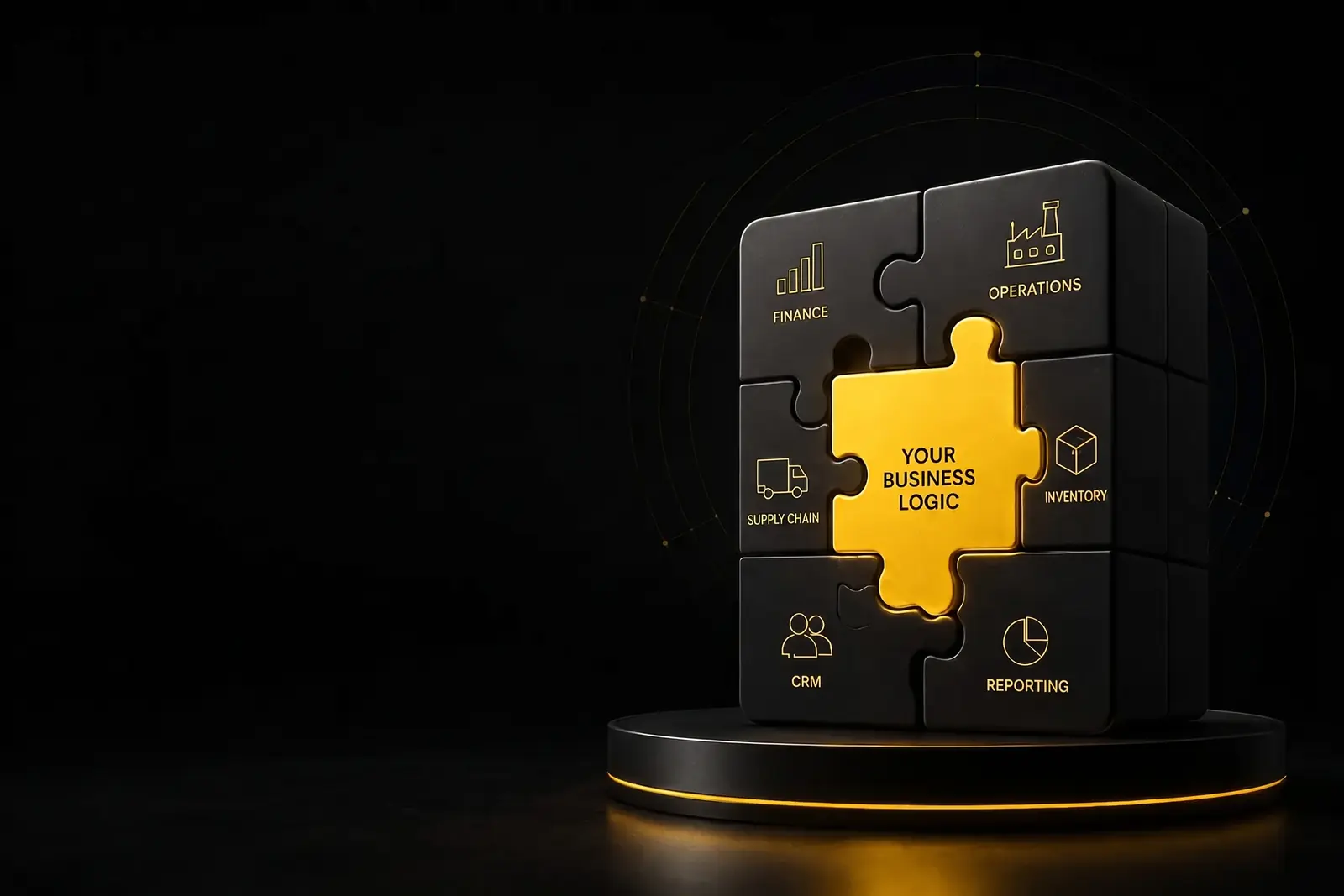
A company can have an ERP, a CRM, an inventory management platform, a billing system, and several other applications that each perform their assigned role.
The operating problem often appears between them.
Consider an order that can no longer follow the standard path. Inventory is unavailable at the expected location. The promised delivery date may need to change.
A substitute product requires approval. Finance needs to review a pricing or credit exception. Customer service is waiting for an answer it can take back to the customer.
Each team has part of the information. No application owns the resolution from beginning to end.
The order moves through inboxes, spreadsheets, messages, and recurring status calls until someone pieces the answer together. The company does not necessarily need to replace its core systems. It needs a business application for the work those systems leave between them.
That is where custom business application development creates value: not by adding software for its own sake, but by turning a workflow the business depends on into an owned capability.
The strongest custom application opportunities are often hiding in plain sight
The process is usually familiar long before anyone proposes custom application development for it.
It is the workflow that relies on one experienced employee to keep it moving. The spreadsheet everyone checks but no one fully trusts. The approval that passes through several departments without a single view of its status. The customer request that cannot be answered until three systems and four people agree.
Order exception management is one version of this problem. The same pattern can appear in:
- A healthcare approval moving between clinical and administrative teams
- A financial review assembled across disconnected records and systems
- A professional services engagement waiting on several internal handoffs
- A media operation coordinating content, rights, approvals, and distribution
- A product organization managing a company-specific release or customer workflow
The industries and business processes differ. The underlying business problem is the same: a critical workflow crosses teams and systems, but no application owns it end to end.
This is a more useful starting point than asking, “What software should we build?”
The better question is, “Which important business outcome are we still coordinating manually because our current systems stop short of the full process?”
A custom business application should own the workflow, not replace everything around it
Custom application development does not automatically mean rebuilding the technology stack.
In the order exception example, the ERP can remain the system that records the order. The inventory platform can remain the source of product availability. The logistics provider can continue managing delivery. The customer relationship management system can still hold the customer relationship.
The missing application sits across that environment and coordinates the company-specific work.
It could bring the relevant information into one workflow, route the exception to the right teams, make the next required decision visible, and show leadership which orders are moving, waiting, or blocked. Once a resolution is approved, the appropriate systems can be updated through seamless integration, without asking employees to repeat the same work in several places.
The value is not another dashboard layered on top of disconnected activity. It is a process that can move consistently from identification to resolution.
For another company, the application may coordinate a compliance review, a service delivery process, a customer approval, or an internal operating workflow. The form changes, but the principle does not: preserve the systems that already perform well, then build the owned application that makes the full business process work.
Define the business outcome before defining the feature list
A custom application development project can become broad very quickly when it begins as a collection of requested features rather than a defined set of business processes to own.
A stronger starting point is a business outcome that leaders and operating teams can both recognize.
For the order exception application, that outcome might be:
Every order exception is identified, assigned, resolved, and reflected across the relevant business systems through one controlled workflow, with clear ownership and visible status at every stage.
That statement does more work than “build an order management tool.”
It defines what the business must be able to do when the application is complete. It also helps separate what belongs in the first production release (the MVP) from what can wait.
A step that routes a credit exception to the right decision-maker may be central to the outcome. Replacing the ERP is not. Giving customer service visibility into the approved resolution may be essential. Building a broad analytics program may be a separate initiative.
This is how a business application stays tied to business value. The application is not finished because a list of screens exists.
It is finished when the defined operating capability works in production.
Turn the Gap Between Your Systems Into a Live Demo
You can probably describe the workflow that’s broken — the handoffs, the spreadsheets, the one person who keeps it moving. The next step is seeing it as software. In week one, unosquare maps that workflow and delivers a working prototype you can actually react to. See what that looks like in practice.
Fixed fee becomes meaningful when the outcome is locked with it
Executives do not need another explanation of why software timelines slip. Many have already lived through a project that began with a clear budget and ended with an unclear finish line.
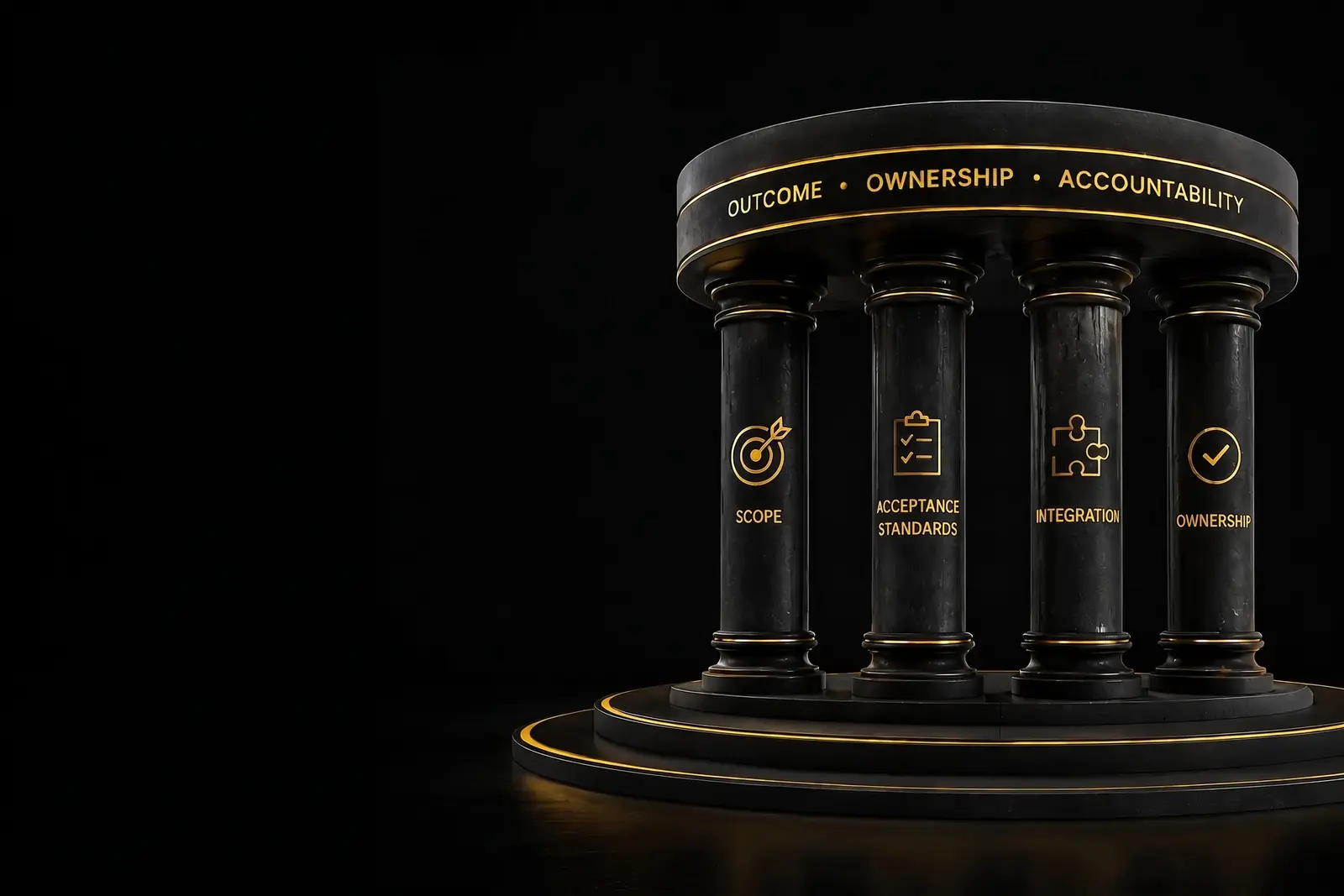
The answer is to decide price, scope, and what “done” means all at once — before anything is built.
A fixed price attached to “an order exception application” still leaves important questions open. Which exceptions are included? Where does the workflow begin and end?
Which systems are involved? What information must each team see? What must happen before the application can be considered production-ready?
Locking all of those questions down before code is written is what actually resolves them.
unosquare locks the scope, budget, and timeline around a defined software outcome. The project is scoped before code is written, and success is measured by the ROI delivered rather than billable hours.
For the order exception example, the fixed fee is attached to a working business capability with an agreed design.
It is not a pool of development time directed toward a general objective.
Builds start as low as $100K. If a fixed-fee build takes longer, that is unosquare’s cost, not the client’s.
What the finished application should change in the working day
A useful test for any proposed business application is whether the team can describe the working day after launch.
Before the order exception application, an employee notices a problem and begins assembling the answer manually. Operations checks availability. Finance reviews the commercial impact.
Logistics looks for alternatives. Customer service waits for a decision. Leadership receives an update only after someone consolidates the latest information.
After the application, the workflow itself carries the process:
- An order exception enters one controlled flow.
- The relevant information from existing systems is available in context.
- The application routes the required decisions to the responsible teams.
- Missing information and stalled actions are visible.
- The approved resolution is reflected across the relevant systems.
- Customer-facing teams and leadership can see the current status.
This does not describe a universal product specification. It shows what it means for an application to own a process rather than merely display information about it.
The same test applies to other business applications. A healthcare workflow should move the approval forward. A professional services application should advance the engagement through the required handoffs. A financial review application should coordinate the work and maintain a clear record of what happened and when.
The finished application should change how the business operates, not simply give the existing manual process a new user interface.
How a defined business application moves from workflow to production
unosquare builds custom applications in four phases, taking a defined outcome to working software in 8-12 weeks.
Week 1: Discovery
The discovery phase maps the goals, workflows, and systems involved. Prototyping begins immediately, and a working build is delivered by the end of week one, with no commitment required.
For the order exception application, Discovery would follow the process from the moment an exception is identified through the decisions, handoffs, and system updates required to resolve it.
The objective is to make the intended operating flow visible early.
Instead of asking leaders to approve an abstract description, the prototype gives them something concrete to evaluate. They can see whether the proposed application reflects the business outcome they need before committing to the full build.
Week 2: Solution Architecture
The system architecture and price are locked before the build starts.
At this stage, the application has a defined outcome, an agreed shape, and a clear relationship with the systems around it. UI/UX design, wireframes, and integration points are finalized during this phase. For the order exception workflow, that means defining the process the application will own and how it will work with the company’s existing environment.
The goal is not to predict every future request. It is to make the first production outcome clear enough to price, build, and ship.
Weeks 3-11: Build
Working software is delivered on a regular cadence.
The application develops as one operating capability: the core workflow, the required decisions, the system connections, and the visibility each team needs come together around the outcome defined before code began. Testing and quality assurance run throughout the build rather than at the end, and an MVP is established early to confirm the core workflow performs as expected before the final phases.
Regular delivery keeps the conversation grounded in working software rather than progress reports alone.
Week 12: Deploy and Handoff
The application is deployed production-ready, documented, and client-owned.
Full code, data, and roadmap ownership transfers to the client. The codebase is built to be owned, maintained, and extended as the workflow and business evolve.
Production-ready is part of the outcome
A custom business application becomes part of the company’s daily operation. That creates a higher bar than a prototype or a polished demonstration.
The order exception application must support real teams, real volume, and real operational pressure. It has to remain useful when information is incomplete, when several departments are involved, or when multiple exceptions are moving at the same time.
unosquare designs the architecture for scalability and real load from day one. Before launch, applications are penetration-tested and SOC 2 compliant. User acceptance testing confirms the application performs correctly before it reaches production.
This matters across industries, particularly when the workflow touches customer, operational, financial, or regulated information. Healthcare workflows may require HIPAA compliance. International deployments may carry GDPR obligations.
Once teams rely on the application to move work forward, production readiness is not a later enhancement.
It is part of what “done” means.
Build, integrate, or keep the current tool
A custom application should not be the automatic answer to every process problem.
Sometimes off-the-shelf software already supports the workflow well enough. Sometimes a connection between current systems closes the gap. Sometimes the company-specific process is important enough to justify custom software solutions built entirely around the business.
Low-code tools and no-code platforms can serve defined workflows that do not require complex logic or deep system integration. Citizen developers on internal teams may be able to configure the right solution with the right product.
The decision becomes clearer when leaders focus on the workflow rather than the category of software.
Keep off-the-shelf products where the process is standard and the software already performs the job well. Integrate where current or legacy systems contain the right capabilities but need to exchange information. Build where the company needs a process that its current off-the-shelf tools do not own, particularly when that process affects revenue, cost, compliance, service delivery, or competitive differentiation.
Custom application development becomes the right choice when the workflow is too complex, too company-specific, or too critical to entrust to any available product.
In the order exception example, the case for custom app development is not that the ERP, inventory platform, CRM, and logistics tools have all failed. It is that none of them owns the company’s full exception-resolution process.
The custom business application becomes the controlled layer that turns those separate capabilities into one business outcome.
When custom business application development is the right move
The pattern is usually visible before a formal software initiative begins.
Custom business application development deserves serious consideration when:
- A critical workflow crosses several teams and systems
- Employees spend meaningful time copying information, checking status, and prompting the next action
- Existing software supports parts of the process but not the process as a whole
- Leadership cannot get a reliable view of work in progress
- A business capability has a deadline, but the internal team does not have the capacity to ship it
- The company needs full ownership of the code, data, and roadmap
- A previous internal build or pilot never became a production system
Custom application development addresses each of these patterns with a defined outcome, a clear process from discovery through handoff, and full code ownership.
These conditions can surface in order management, compliance, approvals, customer operations, professional service delivery, enterprise applications, product workflows, and many other areas.
The unifying signal is not the industry or application type. It is the cost of continuing to run critical business processes through fragmented internal tools and manual coordination.
Custom app development replaces that cost with a controlled, owned capability.
Full ownership keeps the application aligned with the business
The workflow will continue to change after launch.
A manufacturer may introduce new exception rules or distribution partners. A healthcare organization may adjust an approval process. A financial services company may need to extend a review flow. A professional services firm may introduce a new offering with different handoffs.
The client receives full ownership of the code, data, and roadmap. The application is delivered production-ready and documented, with a codebase built for ongoing maintenance, extension, and modernization as business needs evolve.
That ownership matters because the application represents the company’s way of operating. It should be able to evolve with the business rather than becoming another dependency the company cannot control.
unosquare has 16 years of custom software development experience and more than 2,500 completed projects behind it. Its client NPS ranks in the top 1% of B2B services, with enterprise experience across regulated industries.
Walk In With a Problem. Walk Out With a Working Prototype.
Week one is a working session, not a scoping document. unosquare maps the workflow, builds a prototype, and shows you exactly what the application would do — before scope and price are locked. No commitment needed to see it. Learn more about how unosquare builds custom business applications.
Frequently Asked Questions
What is custom business application development?
Custom business application development is the creation of software around a specific business process or capability that existing products do not support well enough on their own.
The application may connect current systems, coordinate work across teams, replace a manual workflow, or create a new owned capability. The result may take the form of a web application, an internal tool, or a customer portal. The defining feature is that it is built around the company’s specific process — not a generic workflow designed for the average buyer.
What kinds of processes are good candidates for a custom business application?
Strong candidates are usually workflows the company depends on that cross several teams or systems and still run on spreadsheets, inboxes, duplicate entry, or manual follow-up.
Examples can include order exceptions, approvals, compliance reviews, customer operations, service delivery, customer portals, and company-specific product or revenue workflows.
Do we need to replace our current software stack?
Not necessarily. Custom application development can preserve the systems that already work and own the process between them.
The right answer may be to build, integrate, continue using off-the-shelf software, or combine those approaches. The decision should follow the business outcome rather than a desire to replace software.
How long does a custom business application take to build?
Builds ship in 8-12 weeks. Discovery is week one, Solution Architecture is week two, Build runs through weeks 3-11, and Deploy and Handoff closes week 12.
How much does a custom business application cost?
Builds start as low as $100K. The project is scoped and priced before code is written. The ROI of a well-scoped build comes from time saved, errors reduced, and decisions made faster, not just from the software itself. If the fixed-fee build takes longer, that is unosquare’s cost, not the client’s.
What do we receive in week one?
unosquare maps the goals, workflows, and systems involved and delivers a working prototype. No commitment is required.
The prototype makes the proposed custom app development visible early, so business leaders can evaluate whether it reflects the outcome they need before committing to the full build.
What happens after handoff?
The application is delivered production-ready and documented. Full ownership of the code, data, and roadmap transfers to the client, and the codebase is built to be owned, maintained, and extended.
What if we do not have internal capacity to manage the build?
unosquare manages the full process from discovery through deployment and handoff. This approach is built for leaders who need to ship a defined capability without pulling their internal team into managing a build day to day.
References
-
European Spreadsheet Risks Interest Group. (n.d.). Research and best practice. https://eusprig.org/research-info/research-and-best-practice/
-
Forrester. (2025). Announcing the evaluation of the adaptive process orchestration market. https://www.forrester.com/blogs/announcing-the-evaluation-of-the-adaptive-process-orchestration-market/
-
Deloitte. (n.d.). Public sector cloud integration services. https://www2.deloitte.com/us/en/pages/public-sector/solutions/public-sector-cloud-integration-services.html
-
OWASP Foundation. (2023). OWASP API security top 10 — 2023. https://owasp.org/API-Security/editions/2023/en/0x11-t10/
-
Deloitte. (n.d.). Feeling the vibe: Navigating the new generation of low-code tools. https://www.deloitte.com/uk/en/Industries/financial-services/perspectives/navigating-the-new-generation-of-low-code-tool.html
-
National Institute of Standards and Technology. (2024). The NIST cybersecurity framework (CSF) 2.0 (NIST CSWP 29). U.S. Department of Commerce. https://csrc.nist.gov/pubs/cswp/29/the-nist-cybersecurity-framework-csf-20/final
-
OWASP Foundation. (2025). OWASP application security verification standard 5.0.0. https://asvs.dev/
-
Association of International Certified Professional Accountants. (n.d.). SOC 2® — SOC for service organizations: Trust Services Criteria. https://www.aicpa-cima.com/topic/audit-assurance/audit-and-assurance-greater-than-soc-2/
-
National Institute of Standards and Technology. (2024). Implementing the HIPAA security rule: A cybersecurity resource guide (NIST SP 800-66, Rev. 2). U.S. Department of Commerce. https://nvlpubs.nist.gov/nistpubs/SpecialPublications/NIST.SP.800-66r2.pdf
-
European Parliament and Council of the European Union. (2016). Regulation (EU) 2016/679 (General Data Protection Regulation). EUR-Lex. https://eur-lex.europa.eu/eli/reg/2016/679/oj/eng
Our Editorial Standards
Our content is developed by combining original industry research, analysis from our senior technical team, and the assistance of AI tools. We prioritize accuracy, practicality, and value for our readers, drawing on decades of hands-on software development and delivery experience to translate complex technology concepts into actionable insights.
Important Disclaimer
The information in this article is provided for general informational purposes only and reflects insights available as of the publication date. It does not constitute professional, legal, or compliance advice. Organizations should consult with qualified professionals before making decisions based on the content of this article.

Oscar Rank
Head of Marketing
Oscar Rank is the Head of Marketing at unosquare. He arrived there after a 15-plus year career spanning financial services, retail and technology. His path ran through product management, strategy, data and CRM roles before he made the jump into full-funnel marketing and GTM. He holds a degree in industrial engineering from the University of Toronto, with a specialization in human factors. That systems-first, human-centered mindset shows up in how he runs marketing: build the process, then let the data settle the argument. He writes about how software and AI are changing what’s possible for a business, and how that shifts the trade-offs leaders have to make.