
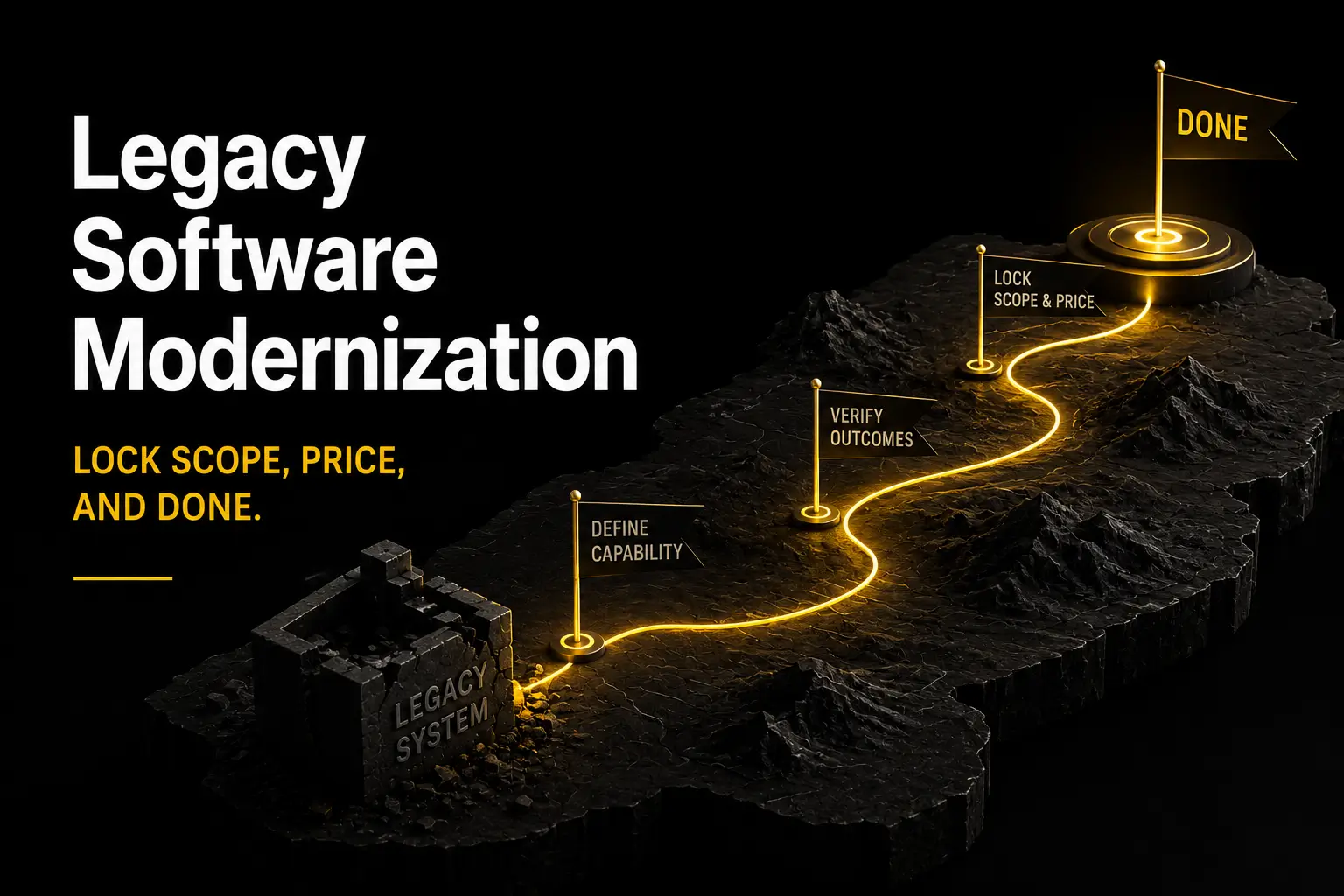
Leadership has authorized modernization of a system the business still runs on. A go-live date is already set. Nobody needs another debate about which path to take. Legacy system modernization work is already funded; the open question is whether the statement of work will buy an operable result.
The open work is how you hire and manage the partner. Structure the engagement so what you pay for is what your team can check and run when the partner steps back.
Fixed-fee pain rarely shows up at kickoff. It shows up at handoff, when code arrived on schedule but operations still cannot run it without the partner in the room. A fixed-fee engagement only works when the business can verify the outcome before the partner leaves. “Done” cannot mean a milestone demo that looked good in a review meeting.
Architecture still matters. It does not reopen the modernization decision. Once the program is authorized, the question narrows: how do you contract for something your team can actually operate?
Example: Bridging One Capability While the Order System Stays Put
That contracting question shows up when leadership keeps the core system and funds one defined capability beside it. A PE-backed manufacturer often hits the same bind: the order system still runs revenue, and nobody will authorize a full rewrite of it this quarter. Cost and board pressure are real, but the core stays off-limits for now.
Build one defined capability beside it: customer order status, inventory reservation, or a fulfillment handoff that today lives in spreadsheets and a few people’s heads. The legacy system stays{2} the system that still owns the official order record. The new piece owns one clear business process, with acceptance tests the operations team can run and sign off.
Whether the authorized path was rehosting, replatforming, or a targeted refactor, the engagement still has to prove that piece is operable.
That scope is fixed-fee territory when “done” is measurable. Name the transactions that must clear. Name the data that must match the order system. Name the live behavior that proves the capability exists.
unosquare delivers a working prototype of the core capability in week one, matches fee to the definition of done in week two, and ships under the same 8–12 week outcome-based model.
One bridged capability the business can run without the partner in the room beats starting a multi-year replacement of a system nobody is ready to retire.
Growth leaders feel the same pressure in a different place. Gary’s team has a campaign approved and a customer-facing portal or personalization path blocked because the legacy customer system or order system cannot support the segmentation or automation the launch requires. The order system stays put; the defined capability beside it is what unlocks the deadline.
Whether you are that manufacturer or another leadership team that already chose the path, the next failure mode is simple: the approved fee and the operable system stop matching.
When the Approved Fee and the Operable System Stop Matching
The bridged capability above only works if the fee buys something operations can run. Once leadership has decided to modernize the applications{1} the business still depends on, digital transformation means getting from that approved decision to a system operations can own.
Cloud migration, lift and shift hosting moves, and deeper refactoring all fail the same way when the fee is approved but autonomy after handoff is not.
A fixed fee is a budget ceiling. The outcome still has to be defined. Engagements that hold share the same skeleton. Name a defined capability. Write pass/fail business tests for acceptance. Link payments to verified delivery milestones. Detail a handoff plan that transfers day-to-day control cleanly.
With those in place from the start, week twelve confirms what operations can run, not what looked good in a milestone demo.
Take a financial services firm hiring a partner for a regulatory reporting workflow under a fixed-fee contract. Code can arrive on time and within budget. Legal obligations can still be met. The internal team still cannot run the thing.
What is worth paying for is a system processing a live transaction, connected to production data, with documentation the internal team can use day to day. Passing the invoice check and passing the operations check are not the same thing.
The pressure is concrete. Revenue sits on a capability that must launch. Compliance has to hold at go-live. The board that approved the budget expects the system to run after the partner leaves. Structuring the engagement before the build begins protects all three.
Leaders reach for clear commercial terms when pressure is already on the deadline and in the budget. Typical triggers include:
- A board-mandated go-live date
- An expiring software subscription
- A prior build that never made it to production
- A compliance requirement with a hard launch date
- A platform approaching end of life
Before you brief the room, get four things straight. Name the required capability. Name the deadline. Name the business outcome that defines success. Confirm willingness to commit to a fixed price for a defined scope.
unosquare builds that discipline into every engagement from day one: payment tied to measurable outcomes and clear acceptance tests, with handoff obligations written into the commercial terms before any contract is signed. Scope, price, and what “done” means get decided together, because those three only hold when they are set at the same time.
Once you can see the gap between the fee and what operations can run, the statement of work is where you close it. BRACE names the five points that belong there before build begins.
BRACE: Execution After the Path Is Chosen
That fee-to-operations gap is an execution problem. unosquare structures the engagement around five BRACE points. Bound outcomes define what “done” means in pass/fail terms. Rate discipline keeps the fee meaningful through milestone payments. Autonomy after handoff names what your team receives so they can run without the partner. Cutover commitments put go-live in writing. Evidence of delivery shows what past performance should look like before you sign.
For a PE-backed manufacturer bridging order status beside a legacy order system, each point maps to something operations can verify before build begins.
| Letter | Checkpoint | What gets settled |
|---|---|---|
| B | Bound outcomes | Pass/fail tests tied to real business processes. Transactions that must clear. Data that must match the order system. Volume and scalability the system must handle. Live behavior that proves the capability exists. All written into the statement of work before build begins. |
| R | Rate discipline | Milestone payments tied to acceptance checkpoints, not invoice dates alone. Change orders with defined triggers, pricing, approval, and separate contracting. Overrun cost stays with unosquare when scope was agreed. |
| A | Autonomy after handoff | Operating guides, post-launch support window, and response-time commitments. Who to call when something breaks. Knowledge transfer so your team can run the capability without the partner in the room. Full code, data, and roadmap ownership with no licensing fee or ongoing dependency. |
| C | Cutover commitments | Go-live plan in the contract{3}. Gating checkpoints. Controlled rollout. Checks that prove new data matches the order system. Accuracy obligations. Recovery steps if a cutover step fails. Not a slide deck after the fact. |
| E | Evidence of delivery | Anonymized project histories with contracted versus actual timelines and budgets. Change-order discipline. Client references who can speak to handoff quality and post-launch operations. |
Settle all five while the week-one prototype is still fresh and the agreement is still being written. That is how a fixed fee stays tied to a system your team can operate through handoff.
Every modernization engagement carries risk. Programs that stay on track name ownership of that risk in the contract before the build begins.
Moving data to the new system gets match targets and staged go-live gates. Data migration success is part of acceptance, not a side task.
Security and compliance get assessment during discovery and tested controls before launch, including known security vulnerabilities that the modernization roadmap must close. Downtime gets defined windows and a committed recovery plan.
Health privacy (HIPAA), data privacy (GDPR), payment-card (PCI), and similar obligations are explicitly in or out of the statement of work, with prior compliance delivery evidence where those standards apply.
Compliance scope and milestone acceptance need executive sign-off. Day-to-day migration details can be delegated with defined reporting schedules.
Each delivery phase produces contract proof, not only a status update. Before those phases start, the fee has to match the capability on paper.
Match Fee to Capability Before You Sign
Once the path is authorized, the scope conversation is the one that matters most. unosquare begins every engagement with a working prototype in week one: a testable demonstration of the core capability, paired with a decision-ready scope definition and cost estimate.
Scope, price, and “done” settle in week two. Once fee and capability match on paper, delivery has to prove the same standard through handoff.
From Prototype to Handoff: Four Phases
Matching fee to capability in weeks one and two only holds if delivery keeps that standard. unosquare builds those commitments into four delivery phases. Payments are tied to business-facing acceptance events. An acceptance owner is named at the start of every engagement. Dispute resolution is defined in the contract before the build begins.
A modernization plan{3} with defined acceptance gates keeps delivery controlled and readable.
For a PE-backed manufacturer bridging customer order status beside a legacy order system, the same four phases apply whether the authorized work is a cloud move, cleanup of aging systems and technical debt, rehosting that lifts the workload as-is, replatforming onto cleaner hosting, re-architecting a module into microservices, or a growth capability beside a platform leadership is not ready to retire.
Containerization and a CI/CD process (automated build and deploy) only matter here when they are named in handoff terms so autonomy after handoff is real.
Discovery and Prototype: Week 1
Week one is where the engagement starts to prove itself. unosquare delivers a working prototype that reads from the order system and returns status the operations team can verify, not a mockup that sidesteps how the new piece connects to the live system.
The same week also delivers a clear capability definition (which transactions must clear, which fields must match), a risk list with owners for order-system dependencies, and a decision-ready scope estimate. No commitment to the full build is required until the prototype makes the match between fee and what operations can run credible.
Solution Architecture and Statement of Work: Week 2
Week two locks what the manufacturer will pay for and what operations can run at handoff. The statement of work maps pass/fail tests to the bridged process: order status queries that return within agreed limits, inventory reservations that match the order system, and explicit exclusions (the order system itself stays untouched).
Milestone payments tie to those checkpoints, not invoice dates alone. How scope changes get approved, how disputes get resolved, and which gates must pass before go-live sit in the same document. That locks BRACE on paper before build begins.
Build: Weeks 3–11
The build runs against the pass/fail tests the statement of work already named, not against a demo script. Working software ships on a steady release schedule, with acceptance reviews at defined intervals.
At each gate, the operations team sees real demonstrations: a status lookup against live order data, a reservation that posts and matches, a fulfillment handoff that clears without manual spreadsheet work. Side-by-side checks show where the bridged capability aligns with the order system and where it does not yet.
Progress is measured in business outcomes the plant can verify, so week twelve confirms what operations can run, not what was hidden behind demo scripts.
Deploy and Handoff: Week 12
Go-live runs beside the order system, not as a full replacement overnight. The bridged capability goes production-ready with operating guides the internal team can follow, checks that prove data accuracy at go-live, and recovery steps if a cutover step does not hold. Code and related materials transfer on defined timelines. Post-launch support and response-time schedules are set before launch.
unosquare‘s obligation is complete when the manufacturer’s team can run order status, reservations, or fulfillment handoffs without the delivery partner in the room: full code ownership, no licensing fee, no ongoing dependency. That is autonomy after handoff as a contractual finish line, not a slide deck promise.
Builds start as low as $100K, scoped before any code is written. If delivery takes longer than the fixed timeline, that cost is unosquare‘s, not yours. Focused modernization projects with well-defined scope complete in 8–12 weeks under this model. Migration complexity, third-party connections, and regulatory review are named during discovery and written into the plan, not found mid-build.
unosquare has completed more than 2,500 projects over 16 years, including regulated-industry work in financial services and healthcare, with a client NPS in the top 1% of B2B services. For Axos Bank, unosquare delivered a platform supporting more than 105,000 monthly active users with 99.9% uptime.
A fixed-fee modernization claim is proven by past performance in specific, checkable form: contracted versus actual timelines and fees, change-order discipline, and whether client teams could operate the system after handoff. You can review that work and related case studies in project-level detail.
The readiness table below shows when fixed-fee execution can start against that bar.
Program Readiness: When Fixed-Fee Execution Can Start
Once modernization is already decided, check whether the program is ready to execute. Legacy modernization{4} succeeds or fails on that readiness. Legacy system modernization that skips readiness checks usually fails at handoff, not at kickoff.
A well-understood scope is a fixed-fee candidate. An ambiguous scope is not, at least not until discovery makes the outcome clear enough to contract for. Scalability targets belong in that scope when growth limits are part of why the program was authorized.
| Readiness signal | What it means for execution | Fixed-fee fit |
|---|---|---|
| Capability named in business terms | The team can describe transactions, data, and live behavior that prove “done” | High: acceptance can be written now |
| Deadline and owner named | A go-live date and acceptance owner sit in the statement of work | High: milestones can be enforced |
| Exclusions written | What is out of scope is explicit, not implied | High: change control stays honest |
| Handoff obligations named | Guides, support window, response times, and who runs the system day to day are contractual | High: the business can run it after partner exit |
| Go-live plan drafted | Migration gates, data matching, and recovery are on paper | High when gates are testable; discovery first if not |
| Connections still undefined | Third-party or data dependencies are still unknown | Low until discovery closes the gap |
| Acceptance still subjective | “Done” is a demo judgment, not a business test | Not ready: start with week-one prototype |
Mixed programs are common. Cloud moves, defined capabilities beside legacy platforms, and compliance-driven streams of work can run in parallel. Each stream still needs its own pass/fail tests and handoff terms.
Some streams replace aging tools with SaaS solutions; others keep custom software and only modernize the connection layer. Use discovery where readiness is incomplete, and apply fixed-fee where the capability is already clear. The fit check below maps those readiness signals to the seats that usually authorize the buy.
Is Fixed-Fee Modernization Right for You?
Fixed-fee fits when conditions like these are already on your desk:
- A non-negotiable delivery deadline
- A required capability that can be expressed as pass/fail business tests
- Limited or unavailable internal delivery capacity
- A previous build attempt that is ready for a clearer engagement structure
- A software subscription that is expiring with a hard replacement date
- A cloud move required before a legacy platform reaches end of life
Start with Discovery when requirements are genuinely exploratory, scope depends on technical assessments not yet complete, or how systems connect is still unknown. For most initiatives that have reached funding and authorization, requirements are stable enough for fixed-fee. Implementation detail is what usually varies, and a well-structured contract handles that through a clear change-approval path.
| Role | Key Trigger |
|---|---|
| CEO | Board-imposed deadline with no internal delivery capacity; digital transformation mandate requiring a production system this quarter |
| COO | Legacy system risk, end-of-life vendor deadline, or growth limits caused by systems that cannot scale; scalability is already a board concern |
| CPO | Product roadmap blocked by a missing capability, technical debt that slows every release, or limits that prevent feature launches |
| CMO/Growth | Campaign or channel launch already approved, but a customer-facing portal or self-serve path must ship beside the legacy platform before the deadline; marketing technology is blocked because the legacy customer system (CRM) or order system cannot support the personalization, segmentation, or automation the campaign requires; artificial intelligence features in the campaign plan stay blocked until that capability ships |
unosquare runs modernization as fixed-fee outcome delivery, not as staffing or an embedded team. When the deadline is non-negotiable and scope can be defined, delivery risk sits with the vendor. When requirements are exploratory and scope is unknown, paying by the hour (time-and-materials) may fit a different buying problem.
A useful cost view should include several inputs: legacy maintenance costs being eliminated, revenue unlocked by modernization, operational risk from aging systems, compliance requirements, and how hard migration and system connections will be. Total cost over the life of the capability matters more than the first invoice alone.
Scope, regulatory requirements, and third-party connections change the fixed-fee estimate. Discovery produces the inputs for a defensible budget proposal that still starts from the $100K floor when the outcome fits. When fit is clear, week one is where you see the capability before the statement of work is locked.
See What You’re Buying Before You Commit
A fit check without a live proof still leaves the fee abstract. unosquare delivers a working prototype of your core capability in week one, before the statement of work is finalized and before the build begins.
Start with the prototype and you get a testable demonstration, a risk list, and a decision-ready cost estimate. No commitment required until you decide the scope and price are right.
Frequently Asked Questions
Once the prototype makes fee and operable capability visible, the questions below usually clear the remaining buy concerns.
How do we know whether our project is the right fit for fixed-fee delivery?
Fixed-fee works when the required capability can be described in testable terms and the delivery deadline will not move. The clearest signals are a compliance date, an expiring software subscription, a prior build that never made it to production, or a board mandate tied to a specific quarter.
If you can answer three questions (what must the system do, what does “done” look like, and when must it be live), fixed-fee is likely the right model. If any of those answers are genuinely undefined, start with Discovery. One week and a working prototype can give you enough clarity to contract for a defined scope.
What do we actually get in week one during Discovery?
You get a working prototype of the core capability, not a slide deck. You also receive a risk list with accountable owners, a validated scope definition, and a decision-ready cost estimate.
These outputs help you decide whether to proceed to a fixed-fee build. They also fill in the acceptance tests and exclusions in the statement of work. If the scope or estimate is not right, you are not committed to the build.
We have worked with partners for years without predictable results. How is this different?
Contract structure changes the incentive. When payments are tied to time spent, the incentive rewards activity. When payments are tied to verified capability, the incentive rewards delivery.
unosquare ties every payment to an accepted milestone: a system that processes real transactions, handles real volume, and meets the criteria defined before the build begins. What “done” means is written into the statement of work before the full build starts. Scope, price, and acceptance stay aligned because they are decided together.
Who owns the source code, data, and hosting setup when the engagement ends?
You own the source code, data flows, documentation, and the setup that runs the system at deployment. There is no licensing fee, no ongoing partner dependency, and no lock-in.
unosquare contracts specify the code transfer timeline explicitly. Escrow arrangements are available if you need code access before final payment clears.
How do we modernize legacy systems without starting a multi-year program?
By scoping modernization to a defined capability rather than the entire system. Successful initiatives treat modernization as a capability-by-capability{5} engagement process, not a company-wide transformation. That is still legacy software modernization; it is just contracted one operable outcome at a time.
Start with the business outcome you need in production: an order-status workflow beside a legacy plant system (ERP), a regulatory reporting system, a customer-facing growth portal beside a legacy customer system (CRM), or a workflow automation capability. Scope that outcome specifically and run it under a fixed-fee model. Name whether the stream needs a second CI/CD (automated build and deploy) handoff, refactoring of hot paths, or only a bounded hosting lift.
unosquare‘s four-phase model delivers production capability in 8–12 weeks. Teams repeat that cycle; it is not a one-time exception.
If modernization is already decided and structuring the engagement is what remains, unosquare gives you a lower-risk way to prove the fee matches what operations can run before the full build: a working prototype, decision-ready estimate, and production plan tied to one defined legacy capability through handoff.
Get Free Prototype and see what can be bought, owned, and operated instead of another open-ended program.
References
- Microsoft. (2025). Select your cloud migration strategies. Microsoft Learn.
https://learn.microsoft.com/en-us/azure/cloud-adoption-framework/plan/select-cloud-migration-strategy - Microsoft. (2026). Strangler Fig pattern. Microsoft Learn.
https://learn.microsoft.com/en-us/azure/architecture/patterns/strangler-fig - Microsoft. (2025). Plan your cloud modernization. Microsoft Learn.
https://learn.microsoft.com/en-us/azure/cloud-adoption-framework/modernize/plan-cloud-modernization - Google Cloud. (n.d.). What is legacy modernization? Google Cloud.
https://cloud.google.com/discover/what-is-legacy-modernization - Google Cloud. (n.d.). Architectural approaches to adopt a hybrid or multicloud architecture. Google Cloud Documentation.
https://docs.cloud.google.com/architecture/hybrid-multicloud-patterns/adopt
Our Editorial Standards
unosquare is committed to accurate, well-researched B2B software delivery information. Our editorial team reviews all content for accuracy and relies on reputable sources including industry analysts, technology standards bodies, academic institutions, peer-reviewed research, and established enterprise software providers. All references are checked for accessibility and relevance at the time of publication.
We aim for accuracy in everything we publish, but mistakes can happen and information can age as delivery models, pricing benchmarks, and technology standards change. If you notice an error or outdated information, please contact us so we can review and update our content.
Important Disclaimer
The information provided on this website is for general informational and educational purposes only. It is not intended as, and should not be interpreted as, professional legal, financial, or technical implementation advice. Always consult with qualified technology advisors, legal counsel, or appropriate professionals before making decisions about software investments, vendor selection, or delivery models. unosquare does not assume liability for actions taken based on the information presented on this site.

Oscar Rank
Head of Marketing
Oscar Rank is the Head of Marketing at unosquare. He arrived there after a 15-plus year career spanning financial services, retail and technology. His path ran through product management, strategy, data and CRM roles before he made the jump into full-funnel marketing and GTM. He holds a degree in industrial engineering from the University of Toronto, with a specialization in human factors. That systems-first, human-centered mindset shows up in how he runs marketing: build the process, then let the data settle the argument. He writes about how software and AI are changing what’s possible for a business, and how that shifts the trade-offs leaders have to make.