What a predictable logistics software build actually delivers
A customer asks where an order is.
Customer service checks the ERP, messages the warehouse, opens a carrier portal, and waits for someone in operations to confirm whether the shipment actually left. The answer eventually reaches the customer, but only because several people knew where to look.
The company may already have enterprise resource planning (ERP) software, warehouse tools, order management systems, transportation management systems, and carrier integrations. What it does not have is one reliable workflow connecting them.
At lower volumes, experienced employees bridge those gaps. As the operation grows, the gaps become the operation. More orders create more status checks, more manual reconciliation, more exception emails, and more people coordinating work that the software was supposed to coordinate.
This is where logistics software development creates value.
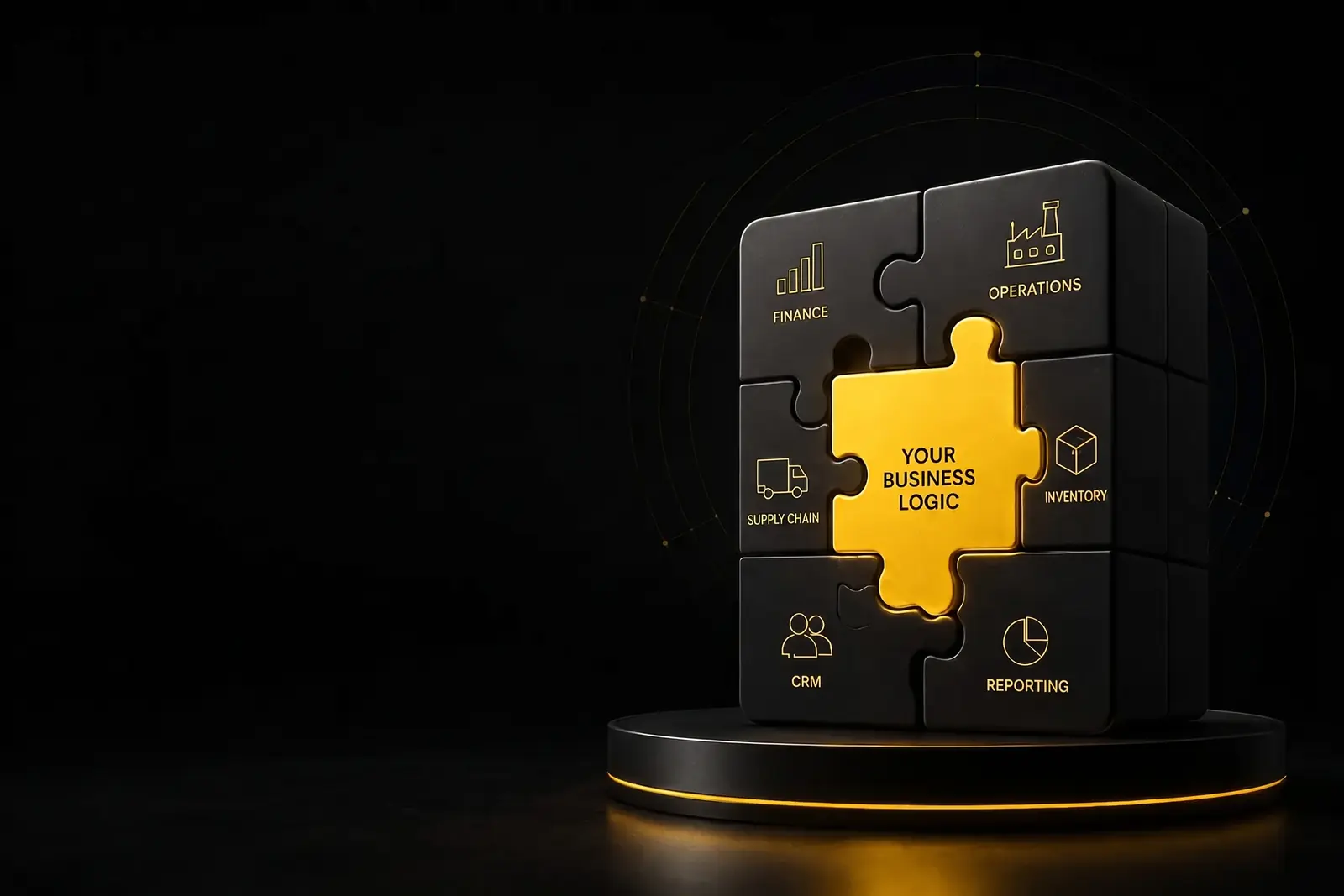
The objective is not necessarily to replace every existing platform. It is to ship a defined business capability that the current stack cannot deliver, such as moving an order from release through order fulfillment and delivery without employees repeatedly entering, checking, and reconciling the same information.
A fixed-fee model becomes useful once that outcome is concrete. The price, scope, timeline, and what “done” actually means can then be built around a working operational result, not a loose list of features.
The real problem is often between the systems
Consider a manufacturer shipping orders from several facilities through a mix of internal fleets, external carriers, and freight forwarders.
Order information begins in the ERP. The warehouse management system (WMS) shows whether inventory has been picked. The transportation management system (TMS) and carrier platforms hold tracking updates. Delivery exceptions arrive through email or phone calls. Customer service maintains a separate spreadsheet because no single system presents the full picture of supply chain visibility.
Each platform may perform its individual job correctly. The business problem exists in the handoffs between them.
Leadership does not necessarily need another large logistics platform. It may need a focused workflow that:
- Pulls order and inventory information from the existing systems
- Shows fulfillment and transportation status in one place, with real-time tracking
- Identifies shipments that need attention
- Assigns exceptions to the right person
- Gives customer-facing teams a dependable status
- Creates a usable record of what happened and when
The same pattern appears in different forms across logistics operations.
A third-party logistics provider may need to onboard customers without creating a new spreadsheet process for every account. A retailer may need inventory and delivery information to stay aligned across stores, warehousing operations, and e-commerce channels. A field service business may need parts, technicians, and customer appointments coordinated through one workflow.
The systems differ. The broader problem is the same: important work depends on people carrying information from one tool to another.
Start with the operational outcome, not the feature list
Logistics projects become difficult when they begin with a catalog of requested features instead of a clear digital transformation outcome.
A request for dashboards, alerts, route optimization, mobile access, shipment tracking, and predictive analytics may sound detailed. It still does not explain what should work differently after the software launches.
A stronger starting point is an operational result that employees and leadership can both recognize.
For example:
When an order is released, the warehouse, transportation team, and customer service team should see the same status. Common exceptions should be identified and assigned without someone compiling information manually.
That statement creates a clear center for the build. Features can then be evaluated by whether they help produce that result.
| Current operational symptom | Capability the business may actually need |
|---|---|
| Dispatchers combine orders, capacity, and driver information manually | A unified dispatch workflow using information from existing systems |
| Customer service checks several platforms for shipment status | One shared view of order, fulfillment, and delivery progress |
| Warehouse and finance teams reconcile inventory adjustments after the fact | A connected inventory management workflow with clear exception handling |
| Managers assemble weekly reports from spreadsheets | A current operational view based on the same information used to run the process |
| Every new customer requires a different manual process | A configurable onboarding and order fulfillment workflow |
| Teams repeatedly enter the same shipment information | Data flowing between systems without duplicate entry |
This approach also prevents a common mistake: trying to modernize the entire logistics environment in a single digital transformation initiative.
The first outcome should solve a meaningful constraint. It should create a working capability that can be used in production and extended later.
See the Connected Operation Before You Commit to Building It
You don’t have to imagine what a workflow connecting your ERP, warehouse, and carrier systems would look like — you can see it. unosquare maps your logistics operation in week one and delivers a working prototype of the connected workflow before any scope or price is locked. See how the fixed-fee logistics build works.
Which logistics capabilities are worth building?
The right priority depends on where coordination work, delays, or poor visibility are limiting the business.
| Logistics capability | Business result it can support |
|---|---|
| Transportation management | Better carrier selection, shipment planning, and cost-to-serve visibility |
| Warehouse management | More consistent receiving, picking, packing, inventory control, and barcode scanning workflows |
| Order management | A clearer path from order processing through fulfillment |
| Fleet management software and telematics | Better use of vehicle location, GPS tracking, maintenance schedules, and driver information |
| Route optimization | More informed routing and dispatch decisions |
| Inventory tracking | A dependable view of inventory movement and availability |
| Last-mile delivery | Clearer delivery progress, proof of delivery, and exception management |
| Customer shipment visibility | Fewer internal status checks and more useful customer updates |
| Demand forecasting | Better-informed inventory, capacity, and labor planning |
| Logistics analytics and data analytics | A shared view of throughput, delays, exceptions, and operational performance |
These capabilities do not always require separate systems.
A company may already have a TMS but still need a customer-facing tracking experience. It may have warehouse management systems in place but lack a practical way to coordinate inventory exceptions with purchasing and customer service. It may have telematics data but no workflow that helps dispatchers act on it.
Custom logistics software is often the layer that turns existing information into a process the business can actually run.
Integration design should follow the workflow
System integration is not valuable simply because two systems can exchange data. It is valuable when that exchange removes a business interruption.
For the manufacturer described earlier, connecting the ERP to the WMS is not the final outcome. The connection matters because it can prevent employees from manually comparing order releases with picking and shipping status.
The right architecture for the integration layer — microservices or a more unified service design — depends on what the workflow actually needs and what the client’s team can realistically support after handoff.
Every integration should therefore answer a practical question.
| System or data source | Business question the connection should answer |
|---|---|
| Enterprise resource planning (ERP) | What was ordered, by whom, and under what commercial terms? |
| Order management system (OMS) | What is the status of each order from capture through processing and fulfillment? |
| Warehouse management system (WMS) | Is the inventory available, picked, packed, or waiting on an exception? |
| Transportation management system (TMS) / carrier or EDI | Has the shipment been accepted, collected, delayed, or delivered? |
| Fleet, GPS tracking, and telematics data | Where is the vehicle, and does the current situation require attention? |
| Customer relationship management (CRM) platform (e.g., Salesforce) | What information should the customer-facing team see? |
| Customer portal | What can the customer view or do without contacting support? |
| Customs or regulatory system | What information or approval is preventing the shipment from moving? |
| Finance system | Which operational events affect billing, charges, or reconciliation? |
The important design decisions are usually operational rather than technical:
- Which system is the dependable source for each piece of information?
- How quickly does the information need to appear?
- What happens when two systems disagree?
- Which exceptions require human review?
- Who needs to act when an exception occurs?
- What should customers, partners, and employees each be allowed to see?
These decisions make the software usable. Without them, an integration can technically work while the original manual process remains in place.
AI and IoT should change a decision, not decorate the roadmap
Artificial intelligence (AI), machine learning, and Internet of Things (IoT) devices can strengthen logistics operations, but only when they help someone make or execute a better decision.
A useful AI capability might identify shipments at risk of missing a delivery window and place them in an exception queue. A demand forecasting model might help operations leaders compare expected demand with available inventory or capacity. An AI agent might extract shipment information from documents and move it into the appropriate workflow for review.
IoT sensors on vehicles or warehouse equipment help operations teams spot maintenance issues before an asset gets assigned to future work. Real-time data from connected devices can also turn a daily manual status check into a live, self-updating view — one that needs scalable cloud architecture when volume spikes.
A machine learning model might route exceptions to the right team based on shipment type. Some operations add blockchain capabilities for supply chain provenance, creating an immutable record of custody for high-value or regulated shipments.
The practical question is not, “Where can we add AI?”
It is, “What decision is currently late, inconsistent, or dependent on someone collecting information manually?”
If the answer is clear, AI can become part of a defined software outcome. If the answer is not clear, the business may be adding another experiment to an already fragmented environment.
What “done” looks like in logistics software development
A completed logistics build should be described in the language of the operation.
For example, “done” might mean:
- An order enters the workflow once.
- Inventory and fulfillment status are pulled from the appropriate systems.
- The shipment is assigned to the correct carrier, route, or dispatch process.
- Employees can see progress without checking several platforms.
- Common exceptions are identified and routed to the right person.
- Customers receive the appropriate status.
- Leadership can see where work is flowing and where it is becoming stuck.
That is more useful than defining success as the completion of individual screens, integrations, or reports.
The same principle applies to a warehouse workflow, fleet application, customer portal, or demand-planning tool. The software is finished when the agreed business capability works in production, not when a collection of features has been demonstrated separately.
A clear outcome also makes fixed-fee delivery more practical. The build can be scoped around:
- The workflow being changed
- The users who need to operate it
- The systems that must be connected
- The business rules and exceptions it must handle
- The information required to make decisions
- Data security requirements and the cloud computing environment
- Quality assurance standards and software engineering rigor governing the handoff
- The code, data, and roadmap that transfer to the client
Scope, price, and the definition of done are decided together because each one depends on the others.
How unosquare delivers a defined logistics outcome
unosquare is a logistics software development company with 16 years of engineering discipline and experience from more than 2,500 completed projects. Its team follows a four-phase process that takes an operational problem to production-ready, client-owned software.
Week 1: Discovery
Business goals, workflows, users, and existing systems are mapped. A working prototype is delivered in the first week, with no commitment required.
For a logistics project, the prototype might show how an order, shipment, inventory exception, or dispatch workflow should move through the future system. Instead of debating an abstract requirements document, leaders can react to something tangible.
Week 2: Solution architecture
The design and price are locked before the build begins.
This phase turns the prototype into a defined software outcome. The systems involved, workflow boundaries, ownership, and expected result become concrete enough to scope and price.
Weeks 3-11: Build
Working software is delivered on a regular cadence.
The focus remains on producing the agreed business capability, whether that is a connected fulfillment workflow, a customer visibility portal, a fleet application, an AI-enabled exception process, or another defined logistics outcome.
Week 12: Deploy and handoff
The software is delivered production-ready with cybersecurity requirements satisfied and full documentation complete. Full code, data, and roadmap ownership transfer to the client.
The result is software designed to be owned, maintained, and extended by the organization after handoff.
Builds start as low as $100K, with the fixed fee scoped before code is written. What previously took months can ship in 8-12 weeks.
If delivery takes longer under the fixed-fee scope, that additional cost belongs to unosquare, not the client.
When this model fits a logistics project
This approach works best when leadership can point to a specific business capability that needs to be working in production.
That may be:
- Replacing a manual dispatch process
- Connecting order, warehouse, and carrier status
- Giving customers a reliable shipment-tracking experience
- Modernizing inventory management software or an application that limits operational growth
- Turning a spreadsheet-based workflow into owned software
- Creating a consistent onboarding process for new customers, partners, or freight forwarders
- Moving an AI logistics concept into production
- Improving how inventory, fulfillment, or transportation exceptions are handled
- Building a capability that existing logistics software does not provide
The organization does not need to have every screen and requirement decided in advance. It does need to know what operational constraint it wants to remove.
The week-one prototype helps turn that constraint into something the business can see, evaluate, and define.
One Week. A Working Prototype of Your Connected Operation.
unosquare maps your logistics operation, identifies the highest-value workflow to fix first, and delivers a working prototype — before scope and price are locked. You see exactly how orders, exceptions, and status would move through the system before committing to the full build. No commitment required. See how unosquare delivers logistics software on a fixed fee.
Frequently Asked Questions
What does logistics software development typically cost?
unosquare builds start as low as $100K. The fixed fee is scoped before code is written.
How long does a logistics software build take?
unosquare delivers defined software outcomes in 8-12 weeks. The process includes a working prototype in week one, solution architecture in week two, the build during weeks three through eleven, and deployment and handoff in week twelve.
Does custom logistics software require replacing our existing systems?
Not necessarily.
Many logistics projects create more value by connecting or extending the systems the business already uses. The right approach depends on whether the current platforms can support the required workflow and where the operational gaps exist.
During discovery, the existing workflows and systems are mapped before the build is defined.
What do we own after handoff?
The client receives full ownership of the code, data, and roadmap. The software is delivered production-ready and documented so it can be maintained and extended after handoff.
Can AI be included in a logistics software build?
Yes, when AI supports a defined production outcome.
Examples include helping teams identify shipment exceptions, process logistics documents, forecast demand, or prioritize operational decisions. The AI capability should be connected to a real workflow rather than treated as a separate experiment.
What if we do not have internal capacity to manage a software project?
unosquare drives the project from discovery through deployment and handoff. It’s built for leaders who need working software without assembling or directly managing a development team.
How does the free prototype help?
The week-one prototype turns the proposed workflow into something tangible. It allows business leaders to see how the capability could work before committing to the full build. See how the logistics build works from week one to production.
References
-
IBM Institute for Business Value. (2023). The CEO’s guide to generative AI: Supply chain. IBM. https://www.ibm.com/thought-leadership/institute-business-value/en-us/report/supply-chain
-
Deloitte. (n.d.). About our digital supply networks services. https://www.deloitte.com/us/en/services/consulting/services/gx-digital-supply-networks.html
-
GS1. (2026). GS1 General Specifications Standard (Release 26.0). https://ref.gs1.org/standards/genspecs/
-
Federal Motor Carrier Safety Administration. (n.d.). ELD frequently asked questions. U.S. Department of Transportation. https://eld.fmcsa.dot.gov/FAQ/ShowAll
-
MIT Center for Transportation & Logistics. (n.d.). Research. Massachusetts Institute of Technology. https://ctl.mit.edu/research
-
World Economic Forum. (2024). Transforming urban logistics: Sustainable and efficient last-mile delivery in cities. https://reports.weforum.org/docs/WEF_Transforming_Urban_Logistics_2024.pdf
-
Accredited Standards Committee X12. (n.d.). Home. https://x12.org/
-
U.S. Customs and Border Protection. (n.d.). Directives and handbooks. U.S. Department of Homeland Security. https://www.cbp.gov/trade/rulings/directives-handbooks
-
National Institute of Standards and Technology. (2021). IoT device cybersecurity guidance for the federal government: Establishing IoT device cybersecurity requirements (NIST SP 800-213). U.S. Department of Commerce. https://csrc.nist.gov/pubs/sp/800/213/final
-
National Institute of Standards and Technology. (2024). Cybersecurity supply chain risk management practices for systems and organizations (NIST SP 800-161 Rev. 1). U.S. Department of Commerce. https://csrc.nist.gov/pubs/sp/800/161/r1/upd1/final
Our Editorial Standards
Our content is developed by combining original industry research, analysis from our senior technical team, and the assistance of AI tools. We prioritize accuracy, practicality, and value for our readers, drawing on decades of hands-on software development and delivery experience to translate complex technology concepts into actionable insights.
Important Disclaimer
The information in this article is provided for general informational purposes only and reflects insights available as of the publication date. It does not constitute professional, legal, or compliance advice. Organizations should consult with qualified professionals before making decisions based on the content of this article.

Oscar Rank
Head of Marketing
Oscar Rank is the Head of Marketing at unosquare. He arrived there after a 15-plus year career spanning financial services, retail and technology. His path ran through product management, strategy, data and CRM roles before he made the jump into full-funnel marketing and GTM. He holds a degree in industrial engineering from the University of Toronto, with a specialization in human factors. That systems-first, human-centered mindset shows up in how he runs marketing: build the process, then let the data settle the argument. He writes about how software and AI are changing what’s possible for a business, and how that shifts the trade-offs leaders have to make.