
The Database Problem Usually Shows Up Somewhere Else First
A leadership team rarely begins with a mandate to build a custom database. The conversation usually starts with a business problem.
A customer operation cannot launch because account data sits in one system, service history in another, and approvals still happen in spreadsheets. The weekly operating report requires several people to reconcile conflicting numbers.
A new compliance requirement exposes how data integrity erodes when the same information lives in multiple systems, and how difficult it is to show who changed a record and when. An AI initiative stalls because the underlying data is incomplete, inconsistent, or inaccessible, leaving AI agents without the reliable foundation they need to act.
Each legacy system may still work on its own. The problem is that the business now depends on those systems working together in a way they were never designed to support.
That is when leaders face the real decision: add another tool, keep extending the current stack, or commission a database system built around the operation itself.
A purpose-built database becomes the right answer when the cost of bending the business around generic software keeps climbing — and building a system that actually fits becomes the cheaper, faster path forward.
The Real Choice Is Between Adapting the Tool and Owning the Workflow
Consider an operations team managing customer onboarding across a CRM, billing platform, document repository, and a set of shared spreadsheets. Or a team that has outgrown Airtable and is now managing client relationships across disconnected tools that were never built to work together.
No single system shows whether a customer is fully approved, what information is missing, who owns the next action, or whether the account is ready to go live. Employees compensate by copying data, sending status updates, and maintaining their own trackers. Leadership sees the result as slow onboarding. The team experiences it as dozens of small handoffs that can fail.
Adding another off-the-shelf tool may improve one part of the process. It may also create one more place to update.
A custom database changes the question. Instead of asking which platform has the longest feature list, the organization defines the business capability it needs: one controlled record of the customer, a clear workflow for approvals, current status across connected systems, and reporting that does not require manual reconciliation.
The database is not the outcome. The outcome is a working operation that the company can run, change, and own.
What Predictable Custom Database Delivery Requires
Custom database development breaks down when the project starts with something like “centralize our data” or “replace the spreadsheets.” Those describe a frustration, not a finished result.
Knowing what done actually looks like is the starting point. For the onboarding operation, that might mean: one employee opens a customer record, sees every required approval, identifies the next action, and produces an accurate status report — without manually assembling anything.
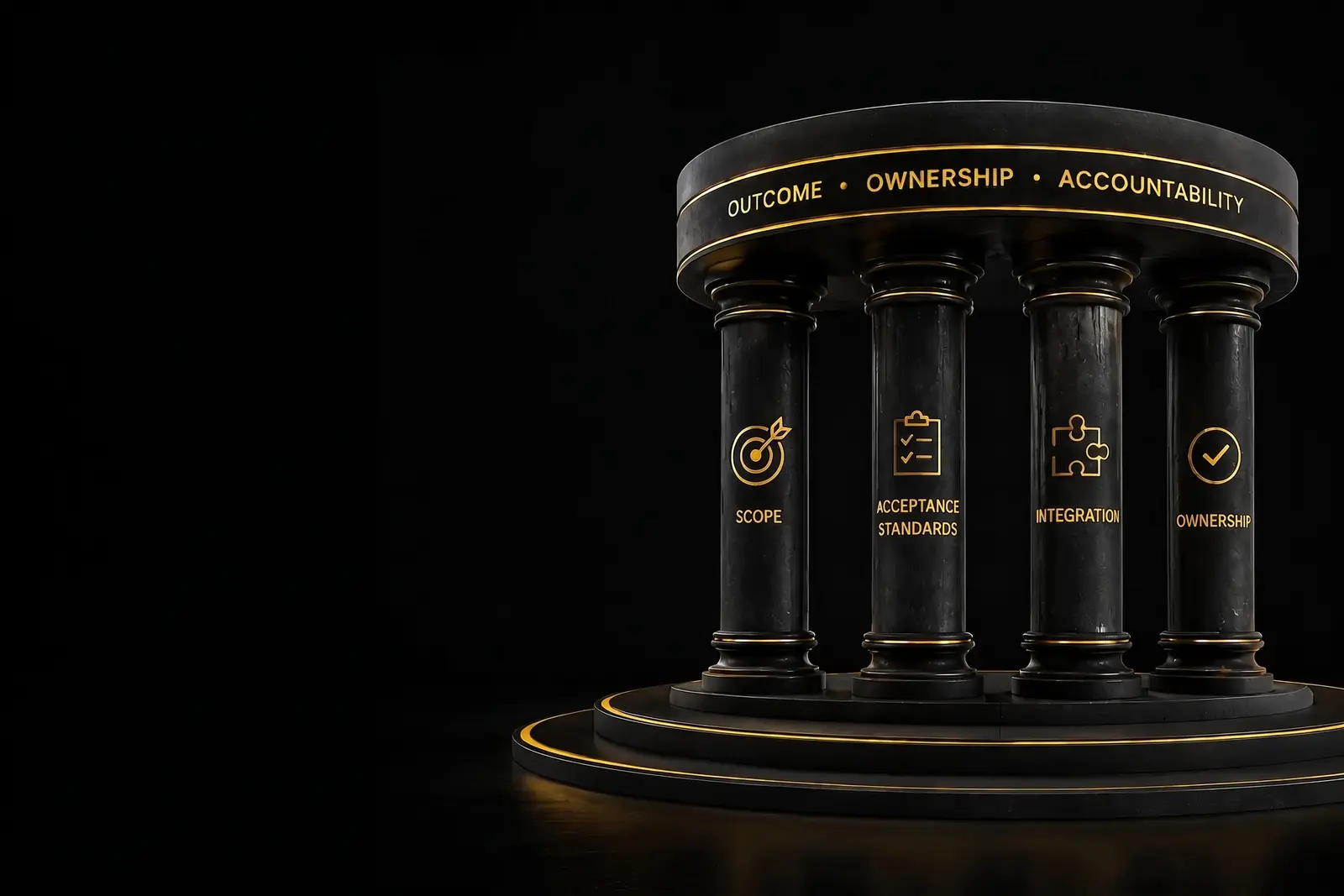
That clarity matters because scope, price, and what done looks like have to be agreed on together before the build starts. Technical requirements are worked out alongside the business outcome — not handed over as a wish list.
This is the difference between buying development hours and paying for a working system. The first leaves the organization responsible for turning effort into a result. The second puts the result at the center of the project.
unosquare’s database development services are structured around four phases:
- Discovery, week one: Goals, workflows, and current systems are mapped, and a working prototype is delivered with no commitment required.
- Solution Architecture, week two: The design and price are locked before the build begins.
- Build, weeks three through eleven: Working software is delivered on a regular cadence.
- Deploy and Handoff, week twelve: The production-ready, documented system is transferred to the client with full ownership.
Builds start as low as $100K, fixed fee and scoped before code is written. If a fixed-fee build takes longer, the additional cost belongs to unosquare, not the client.
What Changes When the Database Fits the Operation
A purpose-built database does more than consolidate records. It removes the operational compromises created by disconnected systems.
In the onboarding example, the immediate change is visibility. The account record, required documents, approval status, and next action no longer need to be reconstructed from several tools.
Teams work from the same current information, and dashboards surface the operational view leadership needs without manual assembly. The systems the company has already invested in can remain connected where they still serve a useful purpose.
The same pattern appears in different forms across the business:
- A healthcare organization may need patient, service, and authorization data to move through a controlled workflow rather than through email and separate trackers, with HIPAA compliance built into the database design, not added after the fact.
- A financial services company may need account activity, supporting documents, and a clear record of changes available in one owned system.
- A manufacturer may need orders, inventory status, and production updates to stay aligned without employees re-entering the same information.
- A media company may need content, rights, approvals, and distribution details connected before an asset can move to market.
- A professional services firm may need client records, project activity, approvals, and billing information to follow one consistent process.
- A staffing organization may need recruitment database software that tracks candidates, placements, and client relationships across one owned workflow rather than across scattered spreadsheets and a generic CRM.
- A membership-driven organization may need membership database software that connects member profiles, renewals, events, and billing without requiring staff to maintain multiple disconnected tools.
- A real estate organization may need real estate database software that connects listings, client relationships, transaction status, and commission tracking in one system rather than across disconnected spreadsheets and point solutions.
These are different industries, but the underlying business problem is the same: a critical workflow depends on data that is fragmented across tools, teams, and manual steps.
Before You Decide, See What a Fixed Database Actually Looks Like
The data problem is clear. What’s less clear is whether building a custom system is the right fix — or whether it’s bigger than it needs to be. Week one answers that: unosquare maps your workflows and data dependencies, then delivers a working prototype before any scope or price is set. See how the process works.
When Custom Database Software Development Is the Right Answer
The workflow is specific to how the company operates
Off-the-shelf software is usually the fastest path when the business can adopt a standard process. Custom becomes more compelling when the workflow itself is part of how the company competes, serves customers, manages risk, or earns revenue.
The signal is not simply that employees dislike the current tool. It is that the tool cannot support the relationships, rules, approvals, or reporting the operation requires without an expanding layer of workarounds.
Several systems need to behave like one operation
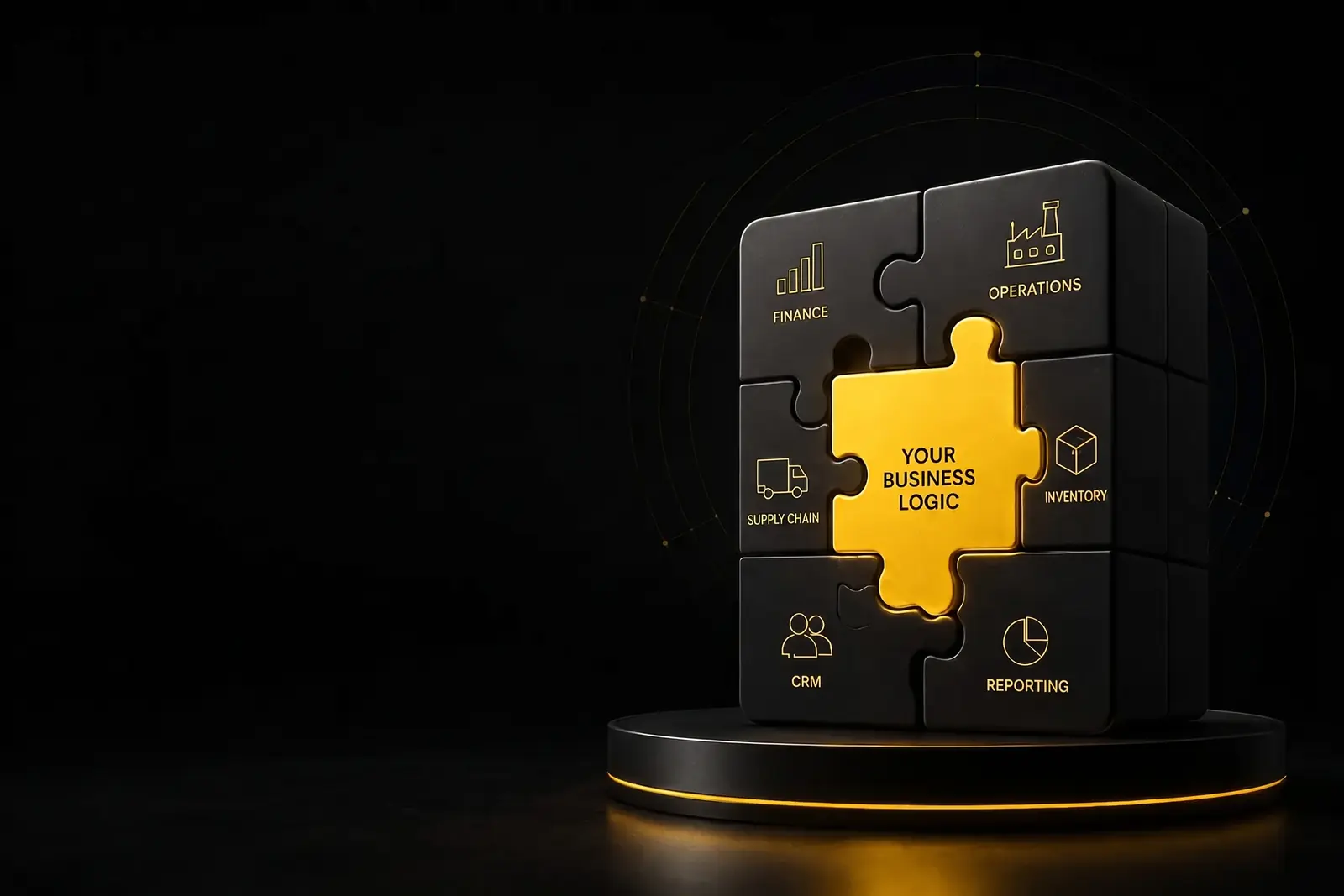
Custom does not always mean replacing the entire tech stack. Often, the better answer is an owned system that connects existing platforms and gives the business one coherent workflow across them.
That matters for organizations that have already spent heavily on CRM, ERP, finance, cloud, or industry-specific software. The question is not whether those investments should be discarded. It is whether they can actually deliver what the business needs on their own.
Ownership and portability are business requirements
A subscription platform can be a strong choice until the company needs control that the platform cannot provide.
Ownership matters when the database supports a core product, holds logic the business depends on, needs to grow without asking a vendor’s permission, or has to stay portable as the organization changes. Software built with those requirements in mind becomes something the company owns and controls — not a service it depends on. With unosquare, full code, data, and roadmap ownership transfers to the client.
Production readiness and compliance cannot be added later
A prototype may prove that an idea works. It does not necessarily mean the system is ready for real users, real volume, or regulated data.
For organizations in healthcare, financial services, and other regulated environments, the database needs to be designed for real operating conditions from the start. The data model, database architecture, access controls, scalability, and data security are design decisions made before the build begins, not features added later.
Technology choices, including whether the primary store is MySQL or another foundation suited to the workload, are part of Solution Architecture. unosquare builds for production from the start: architecture sized for real load, penetration testing before launch, and SOC 2 compliance.
The current workaround is now a business constraint
Manual reconciliation can survive for years because each individual task appears manageable. The constraint becomes visible when the company tries to grow, launch a new offering, meet a reporting deadline, reduce operating cost, or place automation on top of the existing process.
At that point, the database issue is no longer an internal inconvenience. It is blocking a business outcome.
When Extending the Current Stack Is the Better Choice
Custom database development is not necessary when the process is standard, the available software already supports it well, and platform ownership does not create a meaningful limitation.
An existing SaaS, low-code platform, or tool like Airtable may remain the better choice when:
- The workflow can reasonably follow the platform’s standard structure
- The process is still changing too quickly to define a stable outcome
- The database supports a temporary or low-risk internal need
- The organization does not need independent control over the code or roadmap
- The required integrations and reporting are already available without extensive workarounds
The goal is not to build custom software wherever possible. It is to stop paying for operational complexity when the business has clearly outgrown the standard path.
Compare the Operating Model, Not Just the Initial Price
The cost comparison between custom and off-the-shelf software is rarely captured by the subscription fee alone.
A more useful comparison includes the work required to keep the process functioning:
| Decision area | Extending existing tools | Building a custom database |
|---|---|---|
| Workflow fit | The process follows the platform’s structure | The system follows the defined business workflow |
| Ownership | The platform controls the core product and roadmap | Full code, data, and roadmap ownership transfers to the client |
| Integration | Additional connectors and workarounds may be required | Connections are designed around the required outcome |
| Reporting | Data may need to be reconciled across tools | Reporting can be built around one controlled operating view |
| Change | Limited to platform capabilities and policies | The owned system can be maintained and extended |
| Initial path | Often faster for standard needs | Appropriate when the required outcome is already clear |
For the onboarding team, the relevant cost is not only what each platform charges. It is also the time spent updating multiple systems, correcting inconsistent records, chasing approvals, preparing reports, and delaying revenue because an account is not ready to launch.
That is the point at which custom database software development becomes a business investment rather than a technical preference.
A Practical Test Before You Build
Before commissioning a build, or entering a database consulting engagement, ask four questions:
- What business outcome is the current setup preventing? Name the delayed launch, manual cost, reporting gap, customer friction, compliance need, or growth constraint.
- Can the outcome be achieved by changing the process to fit an existing platform? If the answer is yes without creating new operational problems, custom development may be unnecessary.
- Does the company need to own and extend the system independently? Ownership is especially important when the workflow is central to the product, revenue model, or regulated operation.
- Can “done” be shown in a working prototype? A prototype makes the intended workflow concrete before the organization commits to the full build.
If those questions point toward custom database solutions, the next step should make the decision clearer, not simply produce a longer proposal.
The Right Decision Comes After You’ve Seen It Work
unosquare delivers a working prototype in week one — so you can see how the database handles your actual workflows before you commit to building it. Scope and price are locked in week two. No commitment required to reach that point. See how unosquare designs and builds custom database systems.
Frequently Asked Questions
Who owns the custom database after delivery?
Full code, data, and roadmap ownership transfers to the client. The system is delivered production-ready and documented, and the codebase is built to be owned, maintained, and extended.
How long does a custom database build take?
unosquare’s custom database development services ship complete builds in 8-12 weeks. Discovery takes place in week one, Solution Architecture in week two, Build in weeks three through eleven, and Deploy and Handoff in week twelve.
How much does a custom database build cost?
Builds start as low as $100K. It’s a fixed-fee project, scoped before code is written.
What happens if a fixed-fee build takes longer?
If the build takes longer under the fixed-fee model, the additional cost belongs to unosquare, not the client.
Do we need to replace our current software?
Not necessarily. The decision may be to build rather than buy, but it may also be to create an owned system that connects and extends the tools already in place.
Data migration is planned during Discovery, and existing records are validated before the system goes live. Discovery maps the existing systems and the required workflow before the design is locked.
Can our team maintain and extend the system after handoff?
Yes. unosquare delivers a documented, client-owned system, and its codebases are built to be owned, maintained, and extended.
Can the database support regulated or production environments?
unosquare works with clients across regulated industries and builds for production from the start: architecture sized for real load, penetration testing before launch, and SOC 2 compliance — not things bolted on after the fact.
What database technology does a custom build use?
It depends on the data model and use case. Relational databases like MySQL and PostgreSQL handle most enterprise operational workflows well. NoSQL databases like MongoDB are a better fit when the use case involves documents or a schema that needs to stay flexible.
The schema is built around the actual workflow relationships — not a generic structure that forces workarounds. AWS is a common choice for cloud deployment. Volume and scalability requirements are worked out during Solution Architecture.
References
-
European Commission. (2011). EudraLex Volume 4, Annex 11: Computerised systems. https://health.ec.europa.eu/document/download/8d305550-dd22-4dad-8463-2ddb4a1345f1_en
-
Legal Information Institute. (n.d.). 45 CFR § 164.312 — Technical safeguards. Cornell Law School. https://www.law.cornell.edu/cfr/text/45/164.312
-
National Institute of Standards and Technology. (2023). AI risk management framework. U.S. Department of Commerce. https://www.nist.gov/itl/ai-risk-management-framework
-
Deloitte. (n.d.). Medtech CIOs can connect silos, accelerate AI integration. https://www.deloitte.com/us/en/industries/life-sciences-health-care/blogs/health-care/medtech-cios-can-connect-silos-accelerate-ai-integration.html
-
National Institute of Standards and Technology. (2024). Implementing the HIPAA Security Rule: A cybersecurity resource guide (NIST SP 800-66 Rev. 2). U.S. Department of Commerce. https://nvlpubs.nist.gov/nistpubs/SpecialPublications/NIST.SP.800-66r2.pdf
-
U.S. Securities and Exchange Commission. (2023, July 26). SEC adopts rules on cybersecurity risk management, strategy, governance, and incident disclosure by public companies [Press release No. 2023-139]. https://www.sec.gov/newsroom/press-releases/2023-139
-
National Institute of Standards and Technology. (2020). Security and privacy controls for information systems and organizations (NIST SP 800-53 Rev. 5). U.S. Department of Commerce. https://csrc.nist.gov/Pubs/sp/800/53/r5/upd1/Final
-
OWASP Foundation. (n.d.). SQL injection prevention cheat sheet. https://cheatsheetseries.owasp.org/cheatsheets/SQL_Injection_Prevention_Cheat_Sheet.html
-
Association of International Certified Professional Accountants. (n.d.). SOC 2® — SOC for service organizations: Trust Services Criteria. https://www.aicpa-cima.com/topic/audit-assurance/audit-and-assurance-greater-than-soc-2/
-
Amazon Web Services. (n.d.). PERF03-BP01: Use a purpose-built data store that best supports your data access and storage requirements. AWS Well-Architected Framework. https://docs.aws.amazon.com/wellarchitected/latest/performance-efficiency-pillar/perf_data_use_purpose_built_data_store.html
Our Editorial Standards
Our content is developed by combining original industry research, analysis from our senior technical team, and the assistance of AI tools. We prioritize accuracy, practicality, and value for our readers, drawing on decades of hands-on software development and delivery experience to translate complex technology concepts into actionable insights.
Important Disclaimer
The information in this article is provided for general informational purposes only and reflects insights available as of the publication date. It does not constitute professional, legal, or compliance advice. Organizations should consult with qualified professionals before making decisions based on the content of this article.

Oscar Rank
Head of Marketing
Oscar Rank is the Head of Marketing at unosquare. He arrived there after a 15-plus year career spanning financial services, retail and technology. His path ran through product management, strategy, data and CRM roles before he made the jump into full-funnel marketing and GTM. He holds a degree in industrial engineering from the University of Toronto, with a specialization in human factors. That systems-first, human-centered mindset shows up in how he runs marketing: build the process, then let the data settle the argument. He writes about how software and AI are changing what’s possible for a business, and how that shifts the trade-offs leaders have to make.