Off-the-shelf accounting tools are built for the median business. That works until your finance operation no longer looks median.
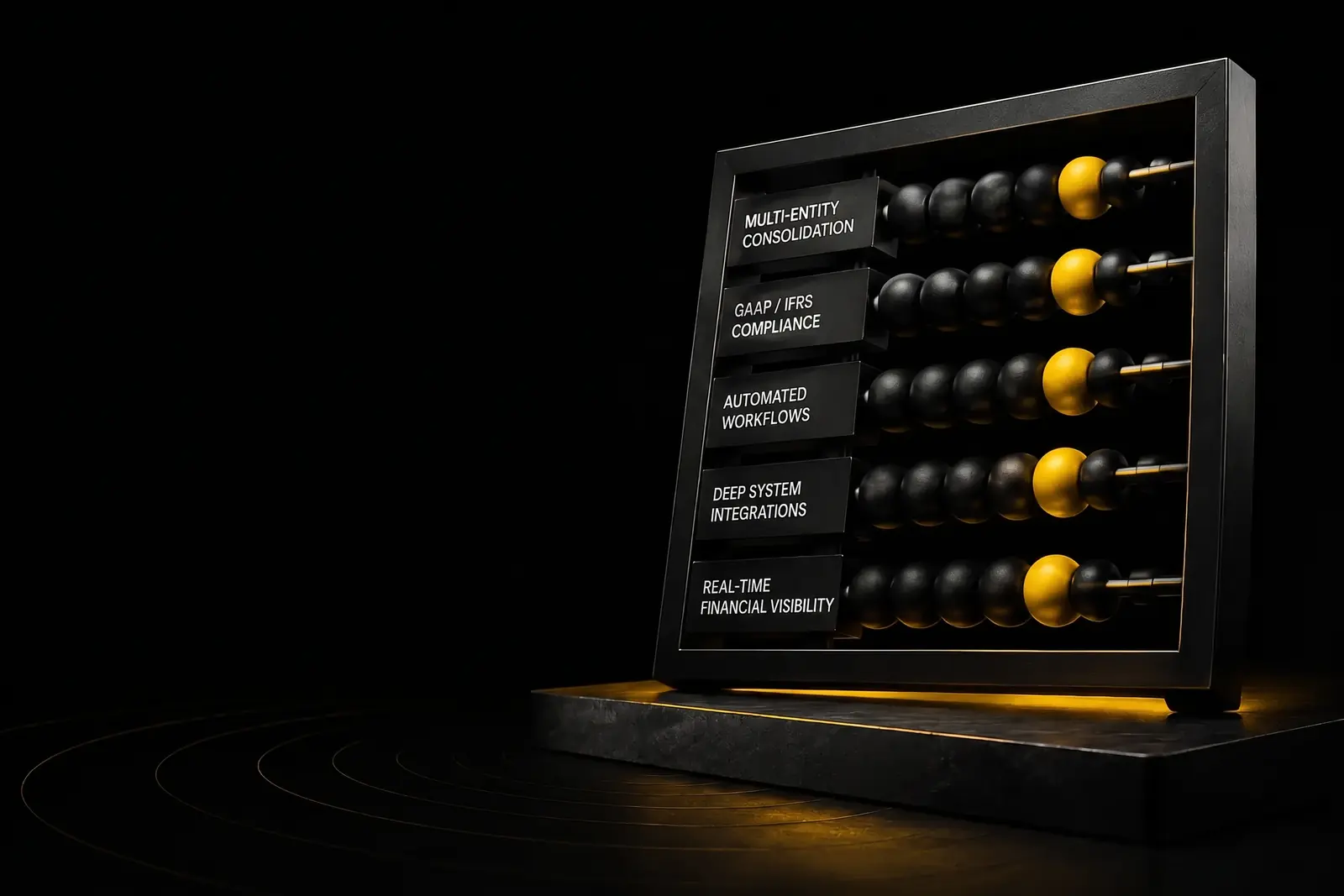
If you are managing multi-entity consolidation, GAAP and IFRS compliance, complex revenue recognition, and integrations across your ERP and CRM stack, you have likely already found the limits of packaged accounting software.
Custom accounting software closes that gap. The question is not simply whether to build. It is how to structure the work so scope, price, and exactly what done means are all locked before a line of code is written.
When QuickBooks Becomes a Liability
You know the moment.
The finance team is using three spreadsheets to reconcile what the accounting system cannot handle. Month-end close takes twelve days because your ERP and accounts receivable systems do not share data. Half the numbers for a board presentation have to be manually compiled before the deck can be built.
Off-the-shelf accounting software handles the basics well: general ledger management, invoicing, bank reconciliation, bookkeeping, and payroll processing. For early-stage or single-entity businesses, it often does the job.
The problem starts when the business grows beyond the median use case.
Multi-entity consolidation, intercompany eliminations, custom revenue recognition rules, GAAP and IFRS compliance, and industry-specific tax logic are not edge cases for mid-market organizations. They are the core of what finance actually does.
At that point, commercial accounting software stops being a solution and starts becoming a constraint.
The Build vs. Buy Decision, Honestly
The phrase “build vs. buy” often hides the more important question:
What do you actually need to own?
SaaS platforms like QuickBooks and Xero are fast to launch and inexpensive in year one. But as complexity grows, per-seat pricing scales with headcount, customization is limited by the vendor’s roadmap, and your processes begin to bend around what the software allows.
Internal builds offer full control and no vendor ceiling. They also require sustained engineering focus, which most mid-market organizations cannot maintain alongside competing priorities. That is why many internal builds stall before reaching production.
Custom software built on a fixed price and locked scope offers a third path. You define what done looks like, lock the price before development begins, and receive a production-ready system on a committed timeline. You own the code, the data, and the roadmap from day one.
The right choice depends on your biggest risk.
| Priority | Right path |
|---|---|
| Speed to basic functionality | SaaS trial: fastest path to baseline capability |
| Long-term control with no vendor dependency | Internal build: best when your team has the capacity and focus |
| Delivery certainty with full ownership | Fixed-fee outcome build: locked scope, price, and definition of done |
The Scope Gets Locked Before You Spend Anything
Most custom accounting builds fail because scope was never clear to begin with — the price changes, the timeline slips, and the team realizes halfway through that they were building different things.
unosquare’s week-one Discovery maps your requirements, produces a working prototype, and locks everything before the build starts. You can see how the process is structured from day one.
What It Takes to Lock a Definition of Done
In any fixed-fee accounting software build, how precisely you define done determines whether the project succeeds.
Scope alone is not enough.
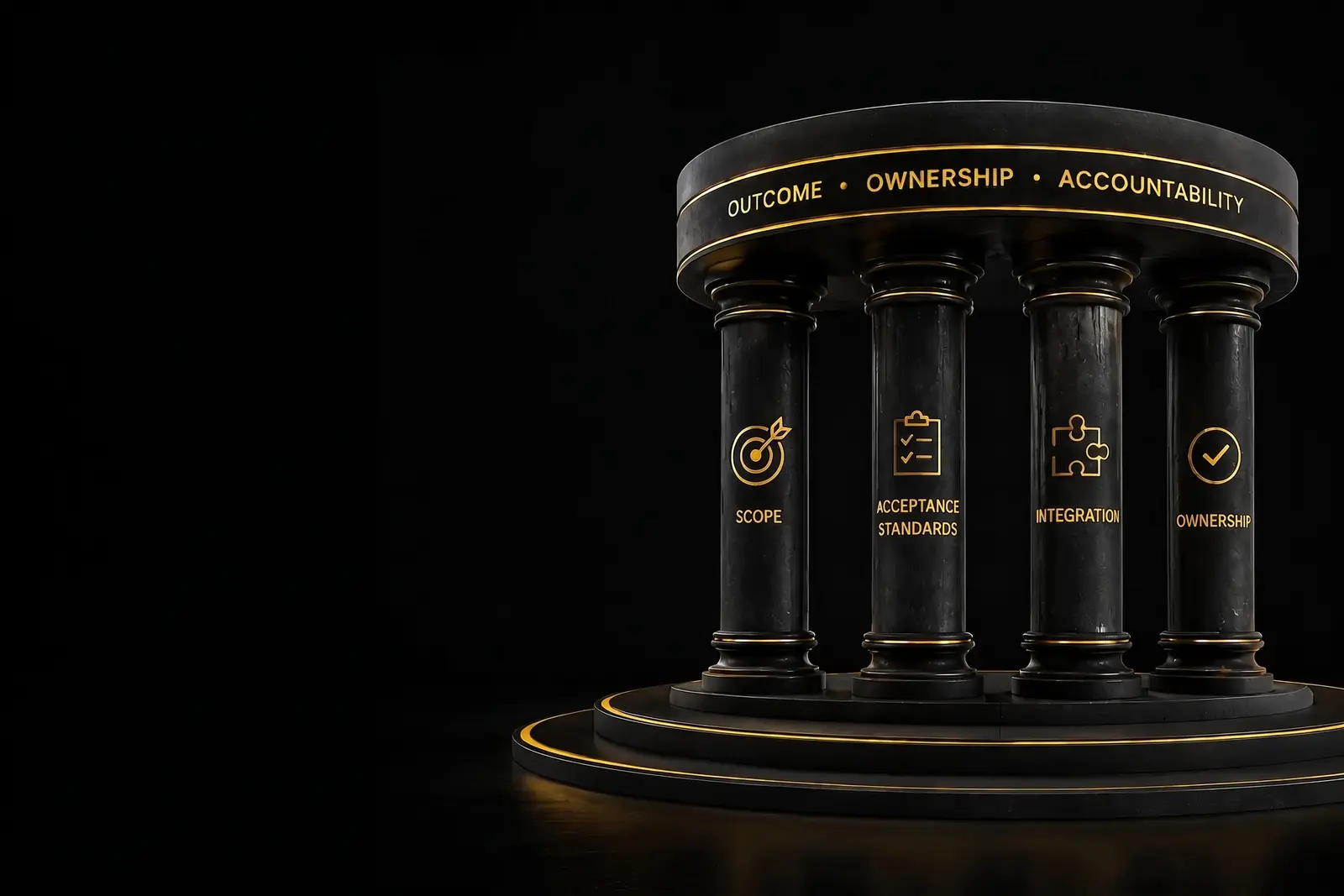
Production acceptance, data migration, named integrations, compliance requirements, and support expectations all need to be defined before development begins, not discovered after handoff.
Five elements should be agreed upfront:
| Element | What it means |
|---|---|
| Code ownership | Full source code and all supporting files are handed to the client at delivery, with no ongoing vendor dependency. |
| Scope with acceptance criteria | Every feature has a measurable test. For example: “Recurring invoices processed with documented accuracy against a defined test data set,” not simply “invoicing module delivered.” |
| Production-environment acceptance | The system is accepted in the live environment, not just a sandbox. This includes migration testing, operational documentation, and a defined post-launch transition period. |
| Named software integrations | Each integration — ERP, CRM, payroll, tax filing platforms, Microsoft Excel exports — is listed by name, with signed test plans and post-launch service levels. |
| Documented first-year support model | Response targets, escalation paths, and enhancement pricing are agreed before launch, not after the client is dependent on the system. |
This is what unosquare locks before writing the first line of code. It is also why fixed-fee custom builds, when structured this way, become a predictable investment rather than a project that expands after the contract is signed.
What Production-Ready Custom Accounting Software Includes
When properly scoped, custom accounting software addresses the gaps that standard tools were never designed to solve.
| Capability | Business impact | Common gap in standard tools |
|---|---|---|
| General ledger with multi-entity structure | Accurate balance sheet consolidation across entities | Manual journal entry management in spreadsheets |
| Automated invoicing and accounts receivable | Faster cash collection and real-time AR aging visibility | Rigid invoicing templates with limited custom fields |
| Accounts payable automation and invoice matching | Fewer manual approvals and lower error rates | Limited workflow customization without add-ons |
| Asset management tracking | Accurate depreciation schedules and compliance-ready reporting | Separate tools requiring manual exports to Microsoft Excel |
| Data security and multi-factor authentication | SOC 2, GDPR, and SOX alignment from day one | Generic security settings that are not tailored to your requirements |
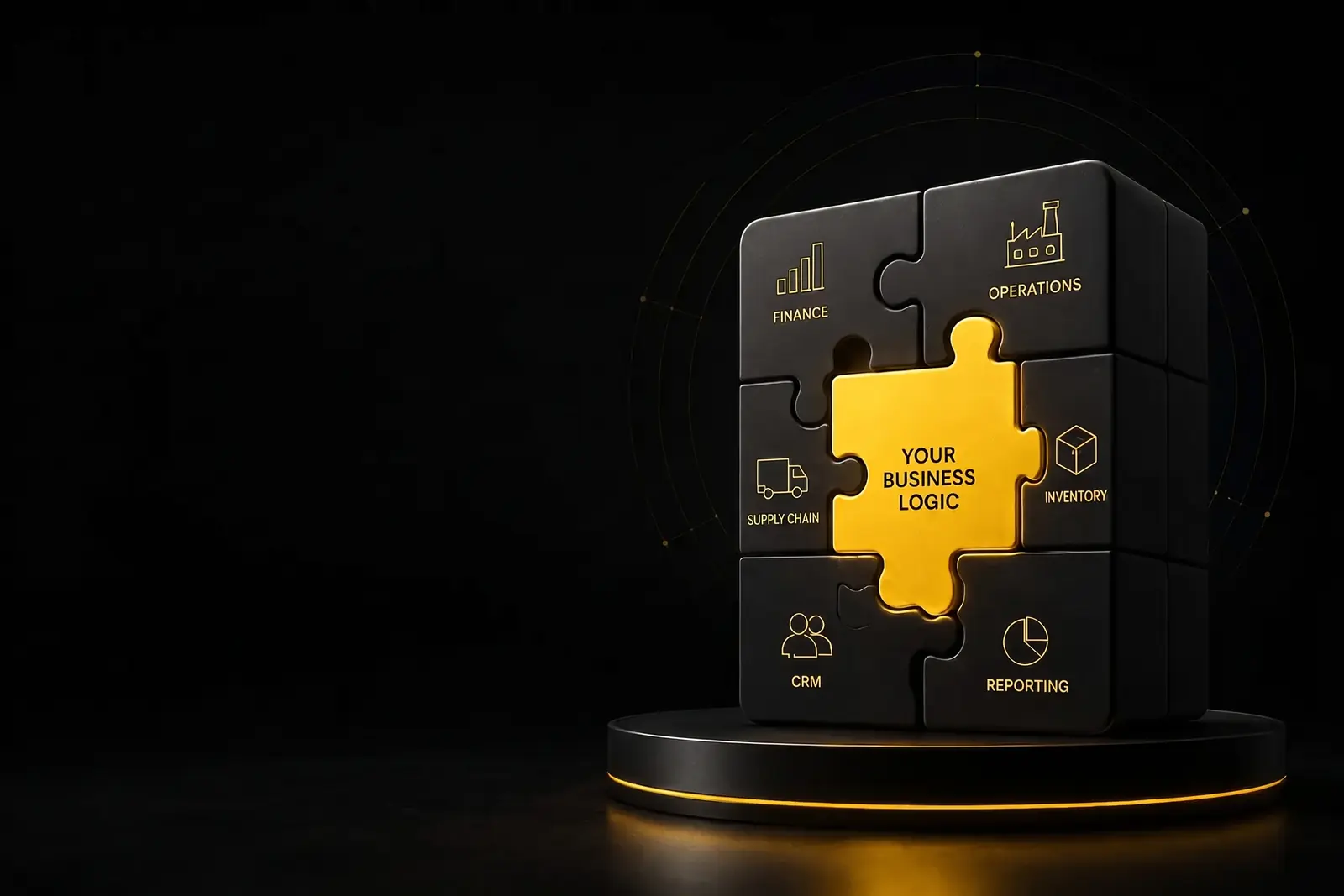
| ERP and CRM software integrations | A single source of truth across finance and operations | Point-to-point connections that break at scale |
A platform built this way is not just a bookkeeping tool. It is a financial operations system designed around how your business actually runs.
Data security is enforced at every layer, from access controls to audit trails, rather than added after the fact.
Each Delivery Model Carries a Different Risk Profile
The best choice depends on where your organization needs certainty.
| Dimension | Packaged software, such as QuickBooks or Xero | Internal build | Fixed-fee custom build |
|---|---|---|---|
| Upfront cost | Low | Low to medium | Fixed and scoped before code starts |
| Timeline to production | Immediate | Unpredictable | Typically 8–12 weeks |
| Customization ceiling | Set by vendor roadmap | None, but resource-constrained | Defined at scope |
| Code and data ownership | None | Full | Full, transferred at handoff |
| Post-launch cost predictability | Per-seat pricing that scales with headcount | Ongoing internal resource cost | Documented first-year model |
| Compliance fit | Generic | Depends on internal expertise | Built to your regulatory requirements |
For organizations navigating GAAP, IFRS, GDPR, or SOX requirements, general-market accounting software can create audit exposure when business logic lives outside the system.
Custom accounting software reduces that exposure by building your compliance requirements directly into the platform.
Is This the Right Fit for Your Situation?
Fixed-fee delivery works best when you know exactly what you need to build, have a real deadline, and understand which integrations are required before scoping begins.
It is not the right fit when the project is still exploratory. If you do not yet know what the system needs to do, a time-and-materials prototype or a closer look at your current tools will get you to clarity faster and at lower cost.
The profiles that benefit most include:
| Profile | Indicator |
|---|---|
| CFO | Month-end close is too slow, or balance sheet consolidation requires manual intervention |
| COO | Manual processes are blocking growth or creating compliance exposure |
| Transformation lead | Board pressure requires visible technology progress this quarter |
Multi-entity rollouts, upcoming compliance deadlines, enterprise migrations, and internal prototypes that never reached production are all signs that a fixed-fee custom build is worth a serious look.
Start With a Prototype, Not a Budget Conversation
Before you commit to anything, see how your custom accounting system would actually work. Week one delivers a working prototype, locked scope, and a fixed price — all before you sign off on the full build. No commitment required to get there. See what unosquare’s fixed-fee accounting build looks like from the inside.
Frequently Asked Questions
How much does custom accounting software cost?
Builds start at $100K, scoped and priced before development begins.
The final number depends on entity count, integration complexity, data migration requirements, and compliance scope. Formal scoping produces a fixed price before any commitment is made.
How long does delivery take?
Under a locked scope, 8–12 weeks is typical.
Discovery happens in week one. Architecture and pricing are locked in week two. Development runs through week eleven. Production deployment and full handoff occur in week twelve.
What do I own at the end?
You own the full source code, deployment files, data exports, and documentation.
Your team can run, modify, and extend the system without ongoing vendor dependency.
When does custom software make more sense than extending our current SaaS stack?
Custom software makes more sense when your processes have outgrown what the vendor’s roadmap can realistically support.
Common signals include:
- Your team uses spreadsheets to bridge gaps between systems.
- You are paying for expensive add-ons to compensate for missing functionality.
- Your compliance requirements, such as GAAP, IFRS, or SOX, require logic that packaged tools do not support.
If the annual cost of workarounds plus subscription fees is approaching the cost of a custom build over three years, the math often favors building. A scoping call makes that comparison concrete with a fixed-price proposal.
What is the real total cost of ownership compared to SaaS over three to five years?
SaaS is usually cheaper in year one. For organizations that have outgrown the standard feature set, it often becomes more expensive from year three onward.
Per-seat pricing scales with headcount. Customization costs accumulate. Workarounds become permanent operating costs. And the ceiling on what you can build becomes more restrictive over time.
A custom build carries a fixed, documented first-year cost. After that, you own the code and pay only for the changes you actually need. The crossover point depends on entity count, integration complexity, and how much of your current SaaS spend is tied to workarounds.
References
- Financial Accounting Standards Board. (2014). Accounting Standards Update No. 2014-09: Revenue from contracts with customers (Topic 606).
https://storage.fasb.org/ASU%202014-09_Section%20A.pdf - IFRS Foundation. (2014). IFRS 15: Revenue from contracts with customers.
https://www.ifrs.org/issued-standards/list-of-standards/ifrs-15-revenue-from-contracts-with-customers/ - Moss. (2024). The state of finance digitisation report 2023–24.
https://resources.getmoss.com/hubfs/DIGI%20State%20of%20Finance%20Digitisation/EN_State-of-Finance-Digitisation-Report-2024.pdf - Ahmed, R., & Suneson, G. (2024). AI and automation in finance 2024. SAPinsider.
https://sapinsider.org/wp-content/uploads/2025/04/SAPinsider-2024-03-AI-Automation-in-Finance-2024.pdf - Deloitte. (n.d.). Aligning the finance operating model with ERP.
https://www.deloitte.com/ch/en/services/consulting/perspectives/aligning-the-finance-operating-model-with-erp.html - Klippa. (2024). The state of automation in finance 2024.
https://www.klippa.com/en/resources/research/automation-in-finance/ - Temoshok, D., Galluzzo, R., LaSalle, C., Lefkovitz, N., Regenscheid, A., Choong, Y.-Y., Proud-Madruga, D., & Gupta, S. (2025). Digital identity guidelines (NIST SP 800-63-4). National Institute of Standards and Technology.
https://csrc.nist.gov/pubs/sp/800/63/4/final - OWASP Foundation. (2023). OWASP API security top 10 – 2023.
https://owasp.org/API-Security/editions/2023/en/0x11-t10/ - U.S. Securities and Exchange Commission. (2024, May 16). SEC adopts rule amendments to Regulation S-P to enhance protection of customer information (Press release No. 2024-58).
https://www.sec.gov/newsroom/press-releases/2024-58 - Tipalti. (2024). Seizing the AI & automation opportunity: Where CFOs stand in 2024.
https://info.tipalti.com/rs/934-OPL-911/images/Tipalti%20-%20CFO%20%26%20AI%20Research%202024.pdf?version=0
Our Editorial Standards
unosquare is committed to accurate, well-researched B2B software delivery information. Our editorial team reviews all content for accuracy and relies on reputable sources including industry analysts, technology standards bodies, academic institutions, peer-reviewed research, and established enterprise software providers. All references are checked for accessibility and relevance at the time of publication.
We aim for accuracy in everything we publish, but mistakes can happen and information can age as delivery models, pricing benchmarks, and technology standards change. If you notice an error or outdated information, please contact us so we can review and update our content.
Important Disclaimer
The information provided on this website is for general informational and educational purposes only. It is not intended as, and should not be interpreted as, professional legal, financial, or technical implementation advice. Always consult with qualified technology advisors, legal counsel, or appropriate professionals before making decisions about software investments, vendor selection, or delivery models. unosquare does not assume liability for actions taken based on the information presented on this site.

Oscar Rank
Head of Marketing
Oscar Rank is the Head of Marketing at unosquare. He arrived there after a 15-plus year career spanning financial services, retail and technology. His path ran through product management, strategy, data and CRM roles before he made the jump into full-funnel marketing and GTM. He holds a degree in industrial engineering from the University of Toronto, with a specialization in human factors. That systems-first, human-centered mindset shows up in how he runs marketing: build the process, then let the data settle the argument. He writes about how software and AI are changing what’s possible for a business, and how that shifts the trade-offs leaders have to make.